
Hu Shi and the National Language Movement
Hu Shi and the National Language Movement
The illustrious Hu Shi was once a committee member of the Preparatory Committee for the Unification of the National Language (hereinafter referred to as the “National Language Committee”). As a celebrity, was he merely a figurehead, or did he genuinely participate in the National Language movement? In fact, Hu Shi’s role in the early stages of the movement was not to be underestimated.
Stirring the Waves of Vernacular Chinese
As early as 1917, during the first general meeting of the “National Language Research Society,” a grassroots organization advocating for “consistency between speech and writing” and “unification of the national language,” Hu Shi, then in the United States, sent a postcard applying for membership. This was the first letter from a society member written in the vernacular (note 1). At that time, it was extremely unusual for gentlemen to correspond in vernacular Chinese. This postcard suddenly made everyone feel that to promote “consistency between speech and writing,” they had to lead by example. Consequently, members in Beijing, ranging from their twenties to their sixties, resolved to practice vernacular writing. As a result, the recorded sayings of Tang and Song Zen Buddhism and Song and Ming Confucianism, vernacular novels by masters of the Ming and Qing dynasties, and various popular speeches and vernacular announcements in society at the time all became models for learning, initiating a flourishing wave of vernacular writing within the research society.
Hu Shi not only used vernacular Chinese for writing but also went to schools to promote it, which brought him into sharp conflict with traditional scholars. In April 1918, he pointed out in an article, “A Theory of Constructive Literary Revolution”: “Only with a literature in the national language can there be a national language with literature; only with a literary national language can our national language be considered a true national language.” The Outline of Chinese Philosophy at Peking University he completed that year was the first time philosophy was written in vernacular Chinese. The following year, his vernacular edition of A History of Chinese Philosophy was officially published. He wrote in a letter to his close American friend, Miss Edith Clifford Williams: “I first published this proposition (referring to vernacular literature) in January 1916. But it was not until I returned from the United States that we seriously began to create in the vernacular. On January 1, 1918, our monthly magazine published poetry and prose in the vernacular for the first time. By the time this monthly reached its 10th issue, at least 12 other publications had followed us in using the vernacular. Currently, almost all important newspapers and magazines in Beijing have done so. The most exhilarating part is the many emerging vernacular writers; their literary genius has found spontaneous liberation when using vernacular Chinese.”
The vernacular language movement was an important part of the National Language movement, pushing the transition from “Classical Chinese” to the “National Language,” and Hu Shi led this movement with practical actions. He not only wrote essays in the vernacular but also attempted to write poetry in the vernacular, creating The Constellation of Experiments (A Book of Experiments). In the preface to this collection, he stated the primary reason for its publication: “Because, although vernacular prose has spread very quickly and widely over the past year, most people remain very skeptical about vernacular poetry…” He believed the contribution this poetry collection could make was its “spirit of experimentation.” He advocated that “if a living literature is to be created, vernacular must be used as the tool of literature,” and boldly claimed, “Success has always depended on experimentation!”
Li Jinxi called Hu Shi the commander-in-chief of the vernacular movement, specifically emphasizing that “this commander-in-chief was not appointed by anyone, nor was he recommended by everyone, and it certainly wasn’t a position he sought himself; it is simply that the enemy recognized him alone as the commander-in-chief.” This demonstrates Hu Shi’s leadership role in the early National Language movement.
The Striving “Layman”
In April 1919, the National Language Committee was officially established. Hu Shi, along with Qian Xuantong, Liu Bannong, Zhou Zuoren, Ma Yuzao, and Zhu Xizu, were recommended as members by Peking University President Cai Yuanpei. It is worth noting that among the six recommended by PKU, only Hu Shi was not from the Chinese Literature Department; he even referred to himself as a “layman in linguistics.” However, this layman did a vast amount of concrete work.
At the first meeting of the National Language Committee, Hu Shi, along with Liu Bannong, Zhou Zuoren, Zhu Xizu, Qian Xuantong, and Ma Yuzao, proposed the “Method for Unifying the National Language.” Subsequently, the Ministry of Education issued an “Order for National Schools” based on this, changing the Chinese literature subject in national schools to the National Language subject. Hu Shi praised this in his preface to the Alumni Record of the National Language Training Institute: “This one order advanced the innovation of Chinese education by at least twenty years.” He also pointed out: “With a national language and a literature of the national language, some scholars will emerge to study the grammar and pronunciation of this national language; then dictionaries, lexicons, grammar books, and linguistics will appear; only then is the standard of the national language established… Promoting the national language is the only way to set its standard; waiting until a standard is set before promoting the national language is impossible.” In 1920, as acting chairman of the National Language Committee, Hu Shi presided over the discussion of Wang Yi’s proposal regarding the pronunciation of two finals, resolving to increase the 39 phonetic alphabets to 40. The “New Punctuation Mark Proposal” submitted by Hu Shi was also officially passed after revision. In 1922, the National Language Committee passed the “Proposal for Reducing the Strokes of Current Chinese Characters,” and 15 people, including Hu Shi, were recommended as members of the Committee for the Simplification of Chinese Characters (note 2). In the autumn of 1928, when the National Language Committee was reorganized, Hu Shi was again appointed as a committee member by the Ministry of Education.
In fact, Hu Shi had deep attainments in linguistics and philology. In 1918, in a letter “In Reply to Zhu Jingnong” published in Vol. 5, No. 2 of New Youth, he advocated that phonetic writing should adopt polysyllabic words from the vernacular. In November 1919, in Vol. 6, No. 6 of New Youth, he published “A Reply to Chen Maozhi,” discussing how to handle “homophonous but different meaning” polysyllabic words. He agreed with Chen Maozhi on modifying some vocabulary and also pointed out that most words would not be ambiguous as long as they were understood within their context. Regarding Chen’s argument that vernacular was uneconomical, Hu Shi countered that while Classical Chinese saved characters, it took significant time and text to explain during teaching and learning, making it actually less economical. That year, Hu Shi completed an article titled “The Evolution of the National Language,” and his “Tentative Suggestions for Literary Reform,” recommended by Qian Xuantong, entered middle school textbooks.
Besides attending various committee meetings, Hu Shi also participated in discussions such as the “Proposal for the National Language Training Institute.” He occasionally invited Zhao Yuanren, Li Jinhui, Li Jinxi, Qian Xuantong, and Wang Yi to tea gatherings to specifically discuss national pronunciation issues. He once lectured on vernacular grammar at Nanking Teachers College, with the core message being: vernacular grammar can be considered the grammar of the national language. Treating phonetic symbols as the national language is a misunderstanding; phonetic symbols are merely tools to promote the national language. Dialects can serve as a supplement to the national language, given they meet two qualifications: first, they must be the most widely circulated among various dialects; second, they must be the most used and popular in dialect literature. To bridge the diverse understandings of the national language and to enable its development, the most important method is to have a unified grammar that conforms to natural logic.
Hu Shi enjoyed discussing professional issues with people from time to time. In November 1919, he wrote an article on the “Usage of the Character ‘De’” published in the Morning Post. In it, he outlined nine usages of the character “De” (的), responding to the view proposed by Mr. “Zhi Shui” that “the character ‘de’ should be reserved for terminology, while ‘di’ (底) should be used as an auxiliary word.” The publication of this article sparked widespread discussion, with figures like Shen Jianshi, Chen Duxiu, and Fu Sinian rushing to publish responses. Hu Shi also co-authored the “Outline of the ‘Research Collection on Vernacular Poetry’” with Xie Chuzhen and Kang Baiqing. The junior high school textbook he compiled with Gu Jiegang, Ye Shengtao, and Wu Yanyin according to the “New School System Curriculum Standards” was published in 1923. In 1925, after much persuasion by Qian Xuantong, Hu Shi became a contributing writer for the newly launched National Language Weekly, despite already being an extremely busy person. In July 1929, Hu Shi rewrote the “Draft Curriculum Standards for High School Chinese,” which included objectives, homework specifics, time allocation, teaching materials outline, key teaching methods, and minimum graduation requirements.
The Rallying Caller
As a celebrity, Hu Shi’s greatest contribution might have been his rallying power, and he spared no effort in promoting and advancing the National Language movement. In August 1921, taking advantage of a trip back to his hometown, Hu Shi gave a speech on “The National Language Movement and National Language Education.” He divided the movement into five stages: (1) The era of vernacular newspapers, using vernacular as a sharp tool to enlighten the people; (2) The alphabet era, using simplified characters or phonetic scripts as a tool for the illiterate to seek knowledge; (3) The Pronunciation Unification Committee, seeking the unification of the national language; (4) The National Language Research Society, promoting phonetic alphabets and using the national language for textbooks; (5) The National Language literature movement. He emphasized that national language education should focus on children. Shortly afterward, he traveled to Shanghai and lectured again at the National Language Training School. In November, he spoke at the Beijing National Language Training Institute, noting that within just a year and a half since the National Language Committee’s establishment, reaching its current state was truly the result of collective efforts. He advised the trainees: “The national language is a tool for seeking higher knowledge and higher culture. Emphasizing the national language is not for the common folk or primary school students, but for ourselves.”
On the evening of February 18, 1922, Hu Shi attended the National Language Movement Entertainment Assembly with Qian Xuantong, Shen Jianshi, Shen Shiyuan, Ma Youyu, and Zhou Zuoren, giving a speech themed “Why the National Language Should Be Studied.” Later, he explained in his essay “Fifty Years of Chinese Literature”: “For Chinese people to use ‘Classical Chinese’ for literature is just as erroneous as Europeans using Latin to write books four hundred years ago, or the Japanese writing in classical Chinese; it’s equally a case of living people using a ‘dead language’ to create literature.” In August of that year, Hu Shi lectured on “Interest in National Language Teaching” at a training institute for female primary school teachers, hoping they would focus on grammar and literature. In April 1927, Hu Shi gave a speech in San Francisco to overseas Chinese on “The Past and Future of the New Culture Movement.” Addressing the widespread use of Cantonese among overseas Chinese, he said: “Guangdong holds an important position in China in terms of commerce and culture; it is the most modern. Yet linguistically, it remains so conservative. I think this is something the people of Guangdong urgently need to remedy. The only remedy is to learn the national language. If I have another opportunity to speak to you all in the future, being able to converse directly without needing a translator—that is the utility of a unified national language.”
In November 1930, Hu Shi mentioned in “Introducing My Own Thoughts”: “If I have made any small contribution to the Chinese literary revolution movement over these ten-odd years, it only lies in: (1) I pointed out a path to ‘use the vernacular to create new literature.’ (2) I provided a theory of Chinese literary evolution based on historical facts, making people understand that the national language is the evolution of classical Chinese, and making them understand the position vernacular literature holds in the history of Chinese literature. (3) I initiated the attempt at modern vernacular poetry…”
Hu Shi’s influence on the National Language movement went beyond his writing and speeches; it was also reflected in many specific small matters. On March 10, 1922, Chen Yixiu from Shantou, a student of the third cohort of the National Language Training Institute, wrote to Hu Shi, informing him that his establishment of a phonetic alphabet dissemination center in his hometown had gained the county magistrate’s support. He asked Hu Shi to write a letter of recommendation to boost their prestige, a request Hu Shi surely would not refuse. Under the advocacy of Hu Shi and others, the Quarterly Journal of Sinology that same year adopted horizontal writing and full punctuation marks. (At the time, China still predominantly used vertical writing, reading right to left, a mode with many limitations. Unpunctuated classical Chinese made parsing sentences a major challenge, leading to multiple interpretations of a single text.) This new mode gradually became mainstream. On September 8, after a political tea gathering, Hu Shi told Cai Yuanpei and others that he would submit a proposal to the Ministry of Education requesting that all official documents switch to the national language and include punctuation marks. It could be said that Hu Shi’s advancement of every small matter was his truest contribution to the National Language movement.
An Enterprising Seeker of Common Ground
During the National Language movement, Hu Shi was not always the one singing its praises. He was accustomed to setting clear directions for certain matters and also liked to raise objections to certain ideas.
Regarding the unification of the national language: In December 1921, while lecturing at a social gathering of the Ministry of Education’s Sinology Training Institute, Hu Shi proposed: “The unification of the national language, even if achievable in our country, may not necessarily be a good thing. Besides national language literature, in the future, there will also be Wu dialect literature and Yue dialect literature—two types of dialect literature that are very worthy of and must be developed. Writers in Suzhou and Guangdong could create beautiful literature in their dialects, but instead, they refrain from doing so to forcefully conform to a unified national language. Doesn’t this mean losing part of the spirit of literature? Doesn’t this drown out a part of the national spirit? If they are allowed to develop freely, it might seem to hinder the national language, but it actually has very beneficial effects.” This issue gained high attention from linguists in the later stages of the movement; they began extensive dialect investigations and expanded the definition of “National Language,” making dialects a part of it. The introduction of Gwoyeu Romatzyh (National Language Romanization) further provided a solution for the nationalization of dialect pronunciation.
Regarding the issue of standard pronunciation: In 1922, Mr. Zhang Shiyi submitted a proposal to the National Language Committee advocating the use of the Beijing dialect as the standard for the national language. It was withdrawn because Hu Shi and group chairman Zhang Yilin did not approve. Qian Xuantong’s diary on March 18 verified this: “In the evening, Li Shaoxi (note: Li Jinxi) treated Wei Tingsheng to dinner at Xihuachun, inviting Shizhi (note: Hu Shi), Yi’an (note: Wang Yi), Yu’an (note: Lu Ji), and me as company to discuss the national language issue. Wei (note: Wei Tingsheng) also advocated the capital dialect, probably belonging to the camp of Zhang Yishi (note: Zhang Shiyi). But Shizhi and I both do not advocate national language unification, but merely seek its popularization.” Although the Beijing dialect was eventually adopted as the standard pronunciation, the thorough discussion process reflected China’s democratic state at the time and ensured that the National Language Committee paid substantial attention to the treatment of dialects. On this issue, Li Jinxi and Hu Shi had differing opinions, and their disputes extended far beyond this.
Regarding the pathway of the National Language movement: Li Jinxi proposed a “Seven-Tier Pagoda” linking the ideal highest proposition of the movement to the current statutory definitions: “(1) Esperanto as the national language; (2) Romanized phoneticization of Chinese; (3) Exclusive use of phonetic alphabets; (4) The implementation of phonetically annotated Chinese character books and newspapers; (5) The advocacy of new literature; (6) Primary schools switching to vernacular texts; (7) First and second grades in national schools changing first.” After viewing this argument, Hu Shi felt that Li Jinxi was setting the bar too high. He wrote to Li Jinxi expressing his view on the course of the National Language movement, suggesting it should be: (1) Unification of pronunciation; (2) National language textbooks; (3) National language literature; (4) A unified national language movement; As for the future: (5) The establishment of national language literature; (6) Scientific research on the national language (phonetics, grammar, dictionaries); (7) A gradual increase in phonetic scripts; (8) The very distant future—complete alphabetization of the Chinese language and script. Li Jinxi had also once proposed a plan to “replace Chinese characters with phonetic symbols,” which Hu Shi disapproved of, considering it not a simple task. As early as 1918, when publishing “The Problem of Chinese Writing in the Future” in New Youth, Hu Shi elaborated: “I believe China must have an alphabetic script in the future. But there are too many monosyllables in Classical Chinese, so it absolutely cannot become an alphabetic script. Therefore, we must first use vernacular script to replace classical script; then turn the vernacular script into an alphabetic script. As for whether China’s future phonetic alphabet will just use the Roman alphabet, that is another question. I am a layman in linguistics and am not qualified to speak.” Evidently, on this issue, Hu Shi’s views and summaries were much more grounded.
Hu Shi would sometimes actively support ideas that seemed outside the mainstream. In 1934, Hu Shi replied to a letter from Yang Yufu, affirming the insights in his book A Brief Proof of Meaning Within the Phonetic Component of Phono-Semantic Compound Characters. He stated: “Derived out of sounds—all languages are like this; it is a natural law. It has nothing to do with ‘the exquisite craftsmanship of our ancestors.’ This principle is common knowledge for dictionary-checking in countries that use phonetic writing; in our country, it was only in the last hundred years or so that anyone slightly understood this principle.” Drawing characters out of sound, Hu Shi essentially pointed out a developmental direction for the Chinese language.
A Friend to All, Hu Shizhi
Hu Shi’s participation in the National Language movement was also reflected in his interactions and friendships with its figures. Wang Zhao invented the Mandarin Phonic Alphabet, making him a pioneer of the movement. He despised pretentiousness all his life and dedicated himself to speaking honest truth. When he befriended Hu Shi at over seventy years of age, he was already considered a marginalized figure. Hu Shi deeply respected Wang Zhao and specifically wrote the preface for his four-volume Collected Works of Xiaohang (note: Wang Zhao) in 1931.
Lin Yutang was one of the inventors of Gwoyeu Romatzyh and early Chinese typewriters. During his studies in the United States, Hu Shi funded him long-term, and academically, they were fellow travelers. Regarding the National Language movement, during his time in the US, Lin Yutang reported to Hu Shi the opposition among Chinese students studying abroad to vernacular Chinese, and they also met to discuss the issue of the “entering tone” (Rusheng). Lin generally agreed with Hu Shi’s Study on the Entering Tone, but he more strongly believed in Bernhard Karlgren’s theory of three ending consonants b, g, d, which Hu Shi strongly opposed, leaving them to hold their respective views.
Hu Shi had numerous academic discussions with Qian Xuantong. In 1920, Hu Shi wrote to Qian Xuantong: “I haven’t written lecture notes for the national language methodology yet. I truly feel sorry to disappoint your hopes of seeking ‘reinforcements.’ I really want to rouse myself to write down the methods I have already taught and the ones yet to be taught within these ten to twenty days.” Hu Shi’s new punctuation mark proposal was also formed after multiple discussions with Qian Xuantong and others. In 1927, for Qian Xuantong’s 40th birthday, because Qian had once said, “For anyone over forty, there’s reason enough for them to die,” Hu Shi specially composed the “Commemorative Song for the First Anniversary of My Deceased Friend Mr. Xuantong Achieving Martyrdom” to chime in. In March 1928, Hu Shi completed A History of Vernacular Literature and specially invited Qian Xuantong to write the title inscription. Although their personalities were vastly different and they drifted apart later, they always respected each other.
Hu Shi’s interactions with Li Jinxi were entirely due to the National Language movement, experiencing multiple clashes, yet these were purely academic debates. Hu Shi respected every opponent, not to mention a fellow traveler. In April 1927, Hu Shi’s A History of National Language Literature was published by the Beijing Culture Society, with a substitute preface by Li Jinxi at the beginning of the book. In 1948, Hu Shi took the initiative to invite Li Jinxi to co-edit the Chronicle of Qi Baishi, as the Li and Qi families were generations-old friends.
Gu Jiegang once wrote to Hu Shi, informing him that he found several vernacular lyrics composed by prostitutes in Rustic Words from Eastern Qi and analyzed that prostitutes exerted significant power in promoting national language literature. The ordinary scholar-officials’ ability to compose vernacular poetry and lyrics might not be free from the assimilation of prostitutes. Surprisingly, this “Debating Ancient History” scholar, favored by Hu Shi, had such unusual findings regarding the national language, and his exchanges with Hu Shi were practically unrestricted.
In the late 1920s, due to illness and increasing administrative duties, Hu Shi gradually faded from the National Language movement. However, by this time, the movement had taken shape and entered the implementation stage. Subsequent work mostly involved specific affairs like linguistics and philology research and teaching promotion, which were certainly not Hu Shi’s expertise. Yet, his rallying cries and efforts for the National Language movement, as well as his role within it, cannot be underestimated.
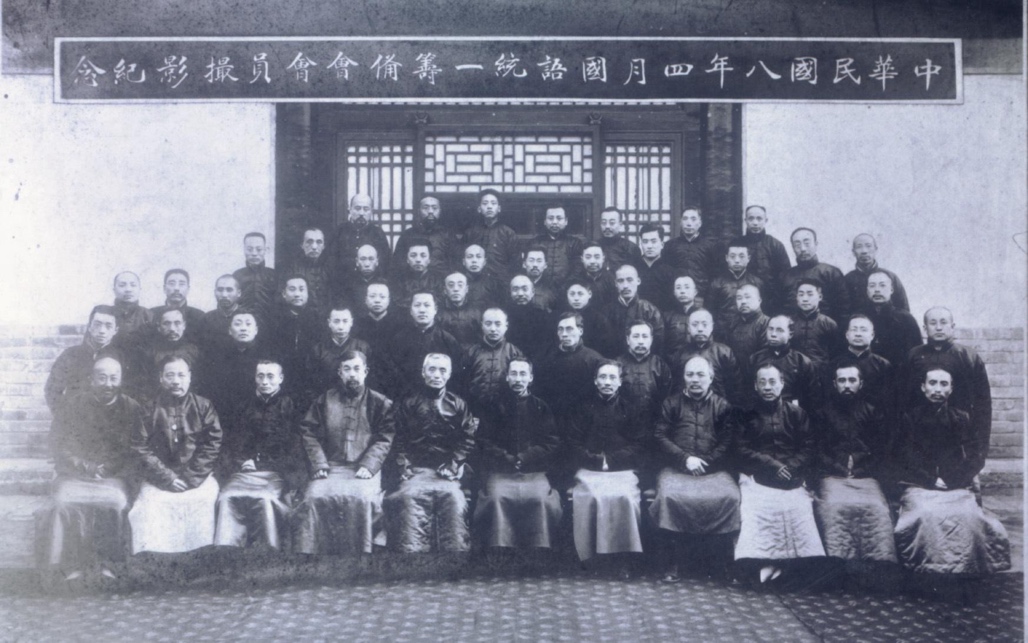
This is a group photo taken on the day the National Language Committee was established. In the front row, from left: 4th is Yuan Xitao, 5th is Zhang Yilin, 7th is Cai Yuanpei, 8th is Wu Zhihui; Second row, from left: 1st is Hu Shi, 5th is Wang Yi, 9th is Zhou Zuoren; Third row, from left: 5th is Qian Xuantong, 6th is Qian Daosun, 10th is Li Jinxi; Fourth row, from left: 4th is Liu Bannong; 9th is Li Jinhui, 10th is Wang Pu.
Comments: Note 1: Vernacular Chinese (Baihua): Opposed to Classical Chinese (Wenyan). It refers to written text based on oral Chinese and processed accordingly.
Note 2: Committee for the Simplification of Chinese Characters: At the fourth general meeting of the National Language Committee in 1922, the “Proposal for Reducing the Strokes of Current Chinese Characters” submitted by Qian Xuantong was passed, and a 15-member committee was established for this purpose. However, this organization had no real achievements. Later, the simplified character scheme proposed during the Republican era was formulated by Qian Xuantong.
References:
A Detailed Chronicle of Hu Shi, by Song Guangbo, Hubei People’s Publishing House, May 2024.
Outline of the History of the National Language Movement, by Li Jinxi, The Commercial Press, May 2011.
March 19, 2026, in Beijing