
"Respect" the National Language, "Persevere" in Unification
Author: Wang Yun
Wu Jingheng was born on March 25, 1865. His original name was Wu Tiao (tiǎo). Because he was fond of the poems of Xie Xuancheng (also known as Xie Tiao, courtesy name Xuanhui), a poet of the Southern Qi Dynasty, and shared the same given name, he chose “Zhihui” as his courtesy name. While teaching at Nanyang Public School, Cai Yuanpei once gave him the nickname “Wu Buheng” (Wu the Inconstant) due to his perceived lack of perseverance in doing things. He gladly accepted the criticism and simply changed his name to “Wu Jingheng” (Jing meaning respect/reverence, and Heng meaning persistence/perseverance), believing that without a heart of “reverence” and “perseverance,” one is unfit to shoulder great responsibilities for the world. From then on, the name Wu Tiao became history.
As an elder statesman of the Kuomintang, Wu Zhihui assisted both Sun Yat-sen and Chiang Kai-shek, and was a highly controversial figure. He was intellectually volatile, possessed a distinct personality, had wide-ranging interests, and dabbled in both politics and culture, making him complex and unique. Though he swore never to become a government official in his life, he served several terms as the head of the National Language Committee (specifically the “Preparatory Committee for the Unification of the National Language” and the “National Language Promotion Committee”). Despite his opposition to birthday celebrations for himself, he accepted a lavish gift from the National Language Committee on his eightieth birthday. While he often started things but failed to finish them, the national language movement was the sole endeavor to which he remained dedicated throughout his life. In terms of his influence on the national language movement, he was a figure of nuclear proportions.
Youthful Invention of “Bean Sprout Characters”
Wu Zhihui was naturally highly gifted, but due to his family’s poverty, he had to open a traditional elementary school at the home of a relative surnamed Feng at the age of seventeen to make a living. This school, which eventually enrolled six or seven students, marked the beginning of his educational career.
After passing the imperial examination for the Xiucai degree at the age of twenty-two, Wu Zhihui entered the Nanqing Academy with the top score in classical studies. He recounted that all his life he could never forget the eight characters written on the academy’s walls: “Seek truth from facts, never be a mediator.” He studied exceptionally hard, using unique methods involving charts and tables; for instance, “for all the characters in the Thirteen Classics, I marked them in red ink in the dictionary; for all the characters in the Shuowen, I mapped them in blue.” To spark his interest in learning, he also composed songs out of various branches of knowledge to chant. For example, the first six lines of The Song of the General Topography of Fujian Counties ran: “Fujian lies twenty-three degrees from the capital, connecting thirteen latitudes down to the south; beginning from East Four to the end of West One, East Six and East Four encompass Taiwan. Its shape is like a square enclosing the southeast, and Taiwan is like a jade pendant under its chin.”
At the age of twenty-six, Wu Zhihui passed the provincial examination to become a Juren because he wrote poems in seal script—the poems were mediocre, but the calligraphy was unique. Later, his two attempts at the metropolitan examinations both ended in failure, but he befriended two people who would have a major impact on his life—Li Shizeng and Lu Erkui. Through Lu Erkui’s introduction, Wu Zhihui later went to Suzhou to teach at the residence of Chen Rongmin, an official of the Wuxian government. He had only one student, and the pay was handsome. During this time, he frequently asked friends to buy The Globe Magazine (Wan Guo Gong Bao) and The Chinese Progress (Shi Wu Bao) from Shanghai. He became highly interested in the phonetic spelling schemes of Lu Ganzhang, Shen Xue, and others published in these periodicals, and discussed these alphabets in correspondences with his friends.
The daily serving of bean sprouts in Chen Rongmin’s home displeased Wu Zhihui. However, one day, he suddenly noticed that these bean sprouts looked remarkably like the phonetic symbols in dictionaries, triggering a flash of inspiration. Following the rhyme system of the Kangxi Dictionary, he created a set of phonetic alphabets. This alphabet consisted of 57 consonants and 18 vowels, totaling 75 characters. Their shapes were simplified strokes derived from independent seal characters or of his own design. Because they resembled bean sprouts, they were dubbed “Bean Sprout Characters.” Nevertheless, Wu Zhihui did not consider himself to have “pioneered phonetic alphabets in China,” as some flatterers claimed. Reflecting on this invention later, he recalled: “Speaking of alphabets, Shen Xue of Suzhou had a system of eighteen strokes in The Chinese Progress… Naturally, there were also Wang Bingyao, Lu Ganzhang, Cai Xiyong, and others, who had learned from Western missionaries long ago and created phonetic symbols… My motivation in making the Bean Sprout Characters was no different from those who borrowed European letters, like Wang Bingyao and others who used simplified strokes or radicals, or the subsequent eighteen strokes of Shen Xue and the Mandarin Alphabet of Wang Zhao—all focused on simplifying characters… When I was in Suzhou, I put the Bean Sprout Characters to practical use, which aligned with the most useful principle: creating many popular textbooks written in Chinese characters with the alphabets annotated alongside. Using correspondence, I successfully taught several relatives who had missed out on education to read.” This shows that Wu Zhihui’s “Bean Sprout Characters” were phonetic symbols rather than simplified characters. He used this alphabet to teach illiterate relatives in his neighborhood, enabling them to correspond with one another in their local dialect. Notably, his wife, who was illiterate, kept in touch with him during his long travels away from home solely by using these “Bean Sprout Characters.” Her letters were reportedly very long, usually running several thousand characters and sometimes exceeding ten thousand words. Yet, despite his later role in presiding over the Pronunciation Unification Conference, Wu Zhihui never promoted his own “Bean Sprout Characters.”
During this phase, Wu Zhihui began to notice the problem that Chinese characters could not be popularized among the general public. In his diary entry for the third day of the tenth lunar month in Renchen (note: 1892) Congchao, he wrote: “Japan has vulgar characters called common characters; in China, characters are only known by educated men.” He also studied the spelling methods of the Manchu twelve-head syllable system.
Western Studies and the Advocacy of Script Reform
In the spring of 1906, Wu Zhihui arrived in Paris, where he later co-founded the weekly journal The New Century (Xin Shiji) with Li Shizeng, Zhang Jiangjiang (note: Zhang Jingjiang), and others. At the time, Wu Zhihui was a passionate anarchist. Corresponding to his political views, he advocated the abolition of Chinese characters in language and script, recommending the adoption of Esperanto instead. He believed: “Esperanto is a powerful tool for the universal dissemination of truth. It is easy to learn and quick to master. If people zealously promote it, it will undoubtedly grow stronger day by day.” While running the newspaper, he found typesetting Chinese characters extremely grueling: “Typesetting Chinese characters is the most laborious task. It is very hard to remember the categories. Moreover, the number of characters is so vast that dozens of type cases occupy yards of space. Selecting type for a single draft is like a donkey rotating in circles or ants turning in a loop; without stepping outside the room, one walks thousands of miles. By contrast, hundreds of Western characters are gathered in a single case, allowing one to sit comfortably and retrieve them, making a vast difference in labor.” He further argued: “If we can discard the more uncivilized Chinese script and adopt a more civilized foreign script, it will certainly give a sharp boost to the Chinese people.”
Wu Zhihui mapped out a route for the dissemination of Esperanto in China along the three great rivers (the West River, the Yellow River, and the Yangtze River), aiming to “ensure that nine out of ten households and nine out of ten people understand Esperanto, in order to accelerate the grand fortune of world progress and awaken the self-awareness of the working people… As long as a single breath remains, this aspiration shall not be slightly slackened.”
In March 1908, a debate concerning Chinese characters and Esperanto unfolded between Zhang Binglin and Wu Zhihui. Aside from their mutual disapproval of the spelling schemes popular in China at the time, they held opposing views on all other matters. Zhang Binglin opposed Esperanto from a nativist standpoint, arguing not only that Chinese pictographs were not inferior to Western phonetic writing, but also that Chinese and Western scripts differed vastly in nature and phonetics. He argued that Esperanto would be difficult to implement due to the inability to distinguish homophones in Chinese and the risk that Chinese dialects would lose their means of communication if the characters were abolished.
Wu Zhihui naturally held his ground, but through this debate, he also realized that the time was not yet ripe to promote Esperanto in China. He began to lean toward treating Chinese characters as “symbols that most people rely on to communicate and express meaning, which must be reluctantly used like an old house. In the short term, we must use it to shelter from the wind and rain, utilizing only the cheapest method to repair it slightly so that the wind and rain do not penetrate.” This cheapest method was what later generations called the “unification of pronunciation,” providing Chinese characters with a “phonetic-annotating wife” to remedy the defect of characters having no standard reading, thereby eliminating dialect barriers among Chinese people. Wu Zhihui thus proposed a three-stage progressive method: first, attaching phonetic symbols next to Chinese characters as an aid; second, studying modern global knowledge and further mastering one or two foreign languages; third, abolishing Chinese characters when the time is ripe. By this time, his advocacy for the urgent unification of language and the attachment of spelling symbols to assist Chinese characters had gradually taken shape.
The 36 consonants and 22 vowels derived by Zhang Binglin from simplified seal script characters during the debate later became the notation tools for the Pronunciation Unification Conference, and were subsequently modified into the officially promulgated Phonetic Symbols (Zhuyin). It must be said that the Zhang-Wu debate had a profound impact on the national language movement.
To promote script reform, Wu Zhihui published articles in The New Century, proposing several ideas: reducing the number of Chinese characters by selecting common characters; simplifying characters; adding new vocabulary as science progressed; changing the layout of Chinese writing from vertical columns read right-to-left to horizontal rows read left-to-right; and adopting Western punctuation marks in Chinese writing. It is clear that by this time, Wu Zhihui had already developed relatively systematic views on Chinese script reform.
Presiding Over the Pronunciation Unification Conference
In March 1909, Wu Zhihui published an important article in The New Century titled “Postscript to the Eastward Spread of Western Learning in Shenzhou Daily,” proposing a grammatical method to remedy the defects of Chinese characters: “that is, to add pronunciation to introductory textbooks… and it is best to follow the style of popular Japanese books, writing Chinese characters in large print with pronunciation annotated alongside.” Furthermore, he emphasized the vital role of dictionaries: “attaching dictionaries is very simple,” and “once the dictionary is completed, anyone should be allowed to reprint it.” He even envisioned the format of the discussions: “If we treat it with slight gravity, it would not be difficult to host a short three-month conference in Beijing or Shanghai. We can invite scholars from the eighteen provinces who are capable of speaking classical Chinese, a few from each province. They would attend the meeting for half a day every day. The secretary would open the dictionary, call out ‘Yi’ (One), and wait for everyone to agree… annotating three to four hundred characters daily… thus the task could be completed in three months.” Wu Zhihui’s ideas, especially the design for determining the official pronunciation, were essentially the embryonic plan for the subsequent Pronunciation Unification Conference.
The earliest concept of “National Language Unification” in China appeared in the preface to Jiangsu New Alphabet written by Zhu Wenxiong in 1906. Late in its reign, the Qing government passed the Proposals for Unifying the National Language, but it was not implemented due to the Xinhai Revolution. Sun Yat-sen once remarked: “Although Shantou and Guangzhou belong to the same Guangdong Province, because of their different pronunciations, merchants from the two places trading overseas sometimes resort to English to converse.” In October of the first year of the Republic, he also proposed the concept of unifying the national language in an interview with journalists. The first Minister of Education of the Republic, Cai Yuanpei, was nominated by Sun Yat-sen, and while it remains unverified, it is highly likely that Sun Yat-sen entrusted Wu Zhihui with the task of national language unification.
In July 1912, the Ministry of Education convened a temporary education conference in Beijing, which passed the Proposal for Adopting the Phonetic Alphabet proposed by Cai Yuanpei, the first Minister of Education. Following this, it was resolved to establish the Office for the Unification of the National Language within the Ministry, and Wu Zhihui was appointed as its director. Wu Zhihui and Cai Yuanpei had met during their studies in Japan and later became close friends in Europe. Wu Zhihui had a solid foundation in ancient Chinese script, had studied in both Japan and the West, and was familiar with both Japanese writing and Western spelling. Combined with his practical and theoretical experience in national language and phonetic symbols, he was the perfect candidate for the role.
Upon taking office, Wu Zhihui threw himself into this work with immense zeal. He drafted the Procedures of the Pronunciation Unification Conference and sent it to all members, which represented the culmination of his years of advocacy for unifying national pronunciation and promoting spelling symbols. The text was divided into ten items: “naming, collection, regulations, examining pronunciation, classifying initials and finals, selecting alphabets, compiling dictionaries, collecting phonetic tables, and promulgating to schools.” These contents show that many of his concepts and specific methods had been brewing for years.
Subsequently, he personally traveled to the banks of the Laishui River to visit Lao Naixuan, a Qing loyalist living in retirement. Lao Naixuan mentioned this in the preface to his General Phonetic Script Chart: “In the spring of Guichou (note: 1913), the Ministry of Education convened the Pronunciation Unification Conference in the capital, presided over by Mr. Wu Zhihui. I was then living in retirement in Laishui. Mr. Wu visited my humble cottage, inviting me to attend. I declined, but presented my views… compiling a copy of Opinions on the Unification of Pronunciation for reference.” Lao Naixuan later sent this five-thousand-word document to Wu Zhihui as a private letter.
On February 15, 1913, the Pronunciation Unification Conference officially opened. The members were famous philologists and scholars from across the country, totaling 80 people, with 44 in attendance. According to the rules of procedure, the conference first elected Wu Zhihui as president (29 votes) and Wang Zhao as vice-president (5 votes) by signed ballot. This marked Wu Zhihui’s absolute leadership in this work, yet the events that followed were beyond his expectations.
The conference first set out to examine character pronunciations. To determine pronunciation, there had to be a notation tool, namely “notation letters” (phonetic symbols), and the issue of “voiced consonants” (voiced initials) became the focus of debate. Wang Rongbao, a representative of Jiangsu, said: “If southerners have no voiced initials and entering tones, they cannot survive,” and at the time, members from Jiangsu and Zhejiang were the most numerous. On the opening day, Wu Zhihui, speaking as president, expounded on the thirty-six initials and four grades of finals, declaring: “These were left to us by our ancestors; we must preserve them!” Gu Shi, a representative of Jiangsu, mocked: “The thirty-six initials were originally created by a monk; are we now to recognize a monk as our ancestor?” As vice-president, Wang Zhao advocated creating new letters to spell the vernacular. Southeastern members insisted that the thirteen voiced initials of the thirty-six initials must be included in the new symbols, a proposal Wang Zhao resolutely opposed. The debate raged for days without resolution. At this point, Wu Zhihui delivered an impassioned speech: “Voiced characters are very robust. German has many voiced letters, which is why their nation is strong; our Mandarin does not use voiced sounds, hence we are weak.” He even sang a segment of Yiyang Opera to demonstrate the robustness of voiced sounds.
This deadlock continued for over thirty days without result. Wang Zhao then devised a method: he proposed that voting should be conducted with one vote per province. The representatives from Jiangsu and Zhejiang were outraged, and Wang Rongbao cried out: “If every province has one vote, from now on all ancient Chinese books will be discarded!” Wang Zhao countered: “Are there no educated people outside of Jiangsu and Zhejiang?” The crowd voiced their agreement. Wang Rongbao confessed with shame: “I have erred,” and walked out. Seeing this, Wu Zhihui delayed putting the matter to a vote for three days. Wang Zhao then led the northern members to bid farewell to Dong Hongyi, the acting Minister of Education: “We outsiders apologize for intruding upon the Jiangsu-Zhejiang Pronunciation Unification Conference for so many days!” Dong Hongyi immediately reassured him: “The vote shall be cast today, and it will surely pass; I will take responsibility.” Thus, the one-province-one-vote system was implemented, and the thirteen voiced initials were discarded.
Gu Shi, originally an old friend of Wu Zhihui, turned against him and publicly stated: “I have never liked this man, and I intend to oppose him!” In truth, Wu Zhihui’s concepts did not conflict significantly with those of the attendees, but his speeches were often endless and overly complex, leaving listeners in a fog. Some thought he was intentionally antiquarian, others felt he was trying to destroy antiquity, and the disciples of Zhang Binglin suspected he wanted to abolish Chinese characters and promote Esperanto. These, however, were mere speculations. Furthermore, Gao Kunnan, a representative of Jiangxi, insisted that his Simplified Notation Method be adopted as the official alphabet and argued so fiercely with Wu Zhihui that he almost came to blows with him. Another member, frustrated that his proposal was not accepted, cursed Wu Zhihui: “You old turtle, you only know how to grin and talk nonsense; you know nothing of phonetics!” The room fell silent as everyone braced for a counter-attack. Yet Wu Zhihui responded humorously: “Oh dear! You must be terribly upset and got it wrong; my surname is Wu, not Wang.” Enduring these episodes, Wu Zhihui lamented: “This seat is no longer tenable!”
Before the conference, Wu Zhihui had received Lao Naixuan’s private letter, which strongly advocated Wang Zhao’s Mandarin Alphabet. Considering the large number of members from Jiangsu and Zhejiang, and fearing that Wang Zhao’s dominance would spark conflicts, Wu Zhihui did not distribute the letter. Near the end of the conference, Lao Naixuan’s eldest daughter, Lao Xiang, attended as an observer and spoke to Wang Zhao about this letter. Wang Zhao demanded a copy of the letter that night and confronted Wu Zhihui on stage the next day. Wu Zhihui replied: “This letter from Yuchu (note: Lao Naixuan’s courtesy name) was a private letter to me. Whether to make it public is my freedom.” Wang Zhao pointed to the phrase “jointly decided by you gentlemen” in the letter: “Let me ask you, is your surname ‘Wu’ and given name ‘Jingheng,’ or is your surname ‘Zhu’ (Jointly) and given name ‘Gongtong’ (Decided)?” Wu Zhihui was furious and resolved to resign. On April 22, Wu Zhihui resigned. By this time, the conference had examined the pronunciations of 6,500 characters and passed the plan to adopt the temporary notation letters as the official “Phonetic Alphabet,” a scheme originally created by Zhang Binglin and put forward by several of his disciples. The vice-president Wang Zhao, who succeeded Wu Zhihui, took sick leave on May 7 due to the cold shoulder from Jiangsu and Zhejiang members. Subsequently, Wang Pu, a representative of Zhili, was elected as temporary chairman, and the remaining agenda was rushed to completion, with the conference closing on May 22.
Wu Zhihui’s performance at the Pronunciation Unification Conference cannot be blamed on him. At the time, there were numerous proposals for phonetic systems, including six or seven from foreigners and over two hundred from Chinese. Wu Zhihui once recalled: “During the Pronunciation Unification Conference, the phonetic symbols collected and investigated came in all styles—Western alphabets, radicals, abbreviations, drawings. Each was crafted with ingenuity, based on classics, rhyme studies, international phonetics, or science. Everyone wanted to be a Cangjie, and everyone thought they had invented a Kharosthi (note: an ancient script used along the Silk Road). Ultimately, they were all focused on phonetic spelling, making it nearly impossible to distinguish or select one over another.” The democratic environment of the conference was typical of China’s early transition to democracy, filled with regional conflicts, academic disputes, personal grudges, and protective attitudes toward one’s own work. Completing the initial goals was already a success.
After the close of the Pronunciation Unification Conference, the political situation shifted, personnel in the Ministry of Education changed, and the achievements of the conference were shelved and ignored. In the summer of 1917, the newly appointed Minister of Education, Fan Yuanlian, recalled the conference and allocated special funds to invite Wu Zhihui to continue the work. Working as the editor-in-chief of Zhonghua Xinbao in Shanghai at the time, Wu Zhihui spared no effort. He arranged the 6,500 characters determined by the conference according to the radicals of the Kangxi Dictionary, added 6,000 essential characters that had not been examined, and included 600 colloquial and modern scientific words, totaling over 13,000 characters, naming the compilation The Dictionary of National Pronunciation (Guoyin Zidian). Upon completing the draft, Wu Zhihui brought it to Beijing. Former member Chen Maozhi invited Wang Pu, Ma Yuzao, Qian Xuantong, and Li Jinxi to his home, where they spent two evenings finalizing the entire draft over dinner. In September 1919, the first edition of The Dictionary of National Pronunciation was published by The Commercial Press, finally bringing the conference’s achievements to fruition. Although this national pronunciation was a mixture of northern and southern accents and had many flaws, it was China’s first attempt to unify Chinese pronunciation.
Leading the National Language Committee
By the time The Dictionary of National Pronunciation was published, the Preparatory Committee for the Unification of the National Language (hereinafter referred to as the “National Language Committee”) had already been established. The Ministry of Education appointed Zhang Yilin as chairman, with Wu Zhihui and Yuan Xitao as vice-chairmen. Among the three, Zhang Yilin came from an official background, and Yuan Xitao passed away shortly after election, leaving Wu Zhihui as the core of the organization.
Wu Zhihui placed great emphasis on phonetic symbols, believing: “Popular education is the fundamental way to save the nation; these phonetic symbols, designed for this urgent crisis, are the best tools for popular education.” “We must know that the primary purpose of creating these phonetic symbols is to bring knowledge and education to the nine-tenths of the Chinese population who are illiterate. These phonetic symbols are truly the savior of four hundred million people. Now that we have this savior, we must immediately strive to propagate them; propagating them one day earlier brings one day’s earlier benefit.” Therefore, the first task of the National Language Committee was to officially promulgate the Phonetic Symbols. When Wu Zhihui heard that Lu Ganzhang was still propagating his “Fast Phonetic Characters” in Fujian and criticizing the Phonetic Symbols, he wrote to Lu Ganzhang to discuss Southern Min phonetic systems and offer counsel. He wrote: “You are the founding father of phonetic spelling. Although the brushstrokes do not follow your system, your immortal thoughts are still embodied in the Phonetic Symbols. Future historians tracing the origins will surely mention your great name. This is an eternal legacy, and there is no need to dwell on the outward forms… The Southern Min phonetic alphabet cannot be made by anyone but you…” Thereafter, Lu Ganzhang ceased his criticisms of the Phonetic Symbols.
At the fifth general assembly of the National Language Committee in 1923, Wu Zhihui, serving as chairman, established the Beijing dialect as the standard pronunciation. He also appointed a 17-member committee, including himself, to revise the dictionary, which resulted in the compilation of the Revised Dictionary of National Pronunciation.
To promote the phonetic symbols, Wu Zhihui had to navigate the Northern Government (Beiyang Government) which he despised, and fight against various conservative forces across the country. In this prolonged campaign, Li Jinxi described Wu Zhihui as the “general headquarters,” yet Wu Zhihui preferred to charge at the front line. In 1924, he established the “National Language Normal School” in Shanghai through The Commercial Press, serving as principal and lecturer. In his sixties, he personally carried the school flag and led the procession, acting as a true vanguard of the phonetic symbols. That year, he also published The Easiest Solution to the Big Problem of Two Hundred Million Commoners, proposing to link the phonetic symbol campaign with popular education and social education, turning the symbols into a “Zhuyin Bodhisattva” that delivers the common people from ignorance. In 1925, he supported the newly launched National Language Weekly by contributing articles. In 1927, Wu Zhihui published Straw Sandals and Leather Shoes, expounding his “Straw Sandal Doctrine”: “Do not despise these phonetic symbols as nonsense; the simpler they are, the easier they are to understand. That is why I have always advocated the ‘Straw Sandal Doctrine.’ Why? The function of shoes is first to protect the feet, and second to walk. Straw sandals are barely enough to protect the feet, but they are unmatched for walking.” He compared phonetic symbols to straw sandals, arguing that in China, where education levels were low, straw sandals were the most economical and practical tool for navigating muddy roads.
In 1928, the National Language Committee was reorganized, and Wu Zhihui was appointed as chairman, continuing to lead its work. At the first annual meeting, Wu Zhihui advocated that the popularization of phonetic symbols should be tested via compulsory training, starting with Nanjing, Beiping, Shanghai, and Wuxi as pilot zones. To prevent public misunderstanding, he proposed renaming the “Phonetic Alphabet” (Zhuyin Zimu) to “Phonetic Symbols” (Zhuyin Fuhao), emphasizing their nature as a tool rather than a script. This proposal was passed by the Central Party Headquarters of the Kuomintang and recommended to the National Government for nationwide implementation.
It must be said that in promoting the national language movement, no one could match Wu Zhihui’s influence on the ruling Kuomintang. As a party elder and tutor to the Chiang family, Wu Zhihui exerted a deep influence on Chiang Kai-shek. In April 1929, the Ministry of Education established the Committee for the Promotion of Phonetic Symbols, appointing eleven members including Wu Zhihui. The committee resolved to establish training schools for phonetic symbols, starting with party and government organs to set an example for the nation. Government organs were required to send one out of every fifty employees to the training classes at Central University to study phonetics, tone exercises, spelling, and notation. Those who completed the training were responsible for promoting the symbols in their respective organizations. The second national education conference passed a proposal put forward by Wu Zhihui and others requesting the Ministry of Education to actively promote the phonetic literacy movement within the shortest time. Meanwhile, Shanghai publishers printed newspapers and magazines with phonetic symbols for publicity, the Ministry of Railways added phonetic symbols to station names, and the signboards of Kuomintang party headquarters and government offices also featured phonetic symbols, marking a peak of popularity.
The Great Chinese Dictionary Compilation Office under the National Language Committee officially began its work. Compiling a systematic dictionary had been Wu Zhihui’s dream for years. On April 28, 1932, as chairman of the National Language Committee, Wu Zhihui petitioned the Minister of Education to publish the Vocabulary of Common National Pronunciation (Guoyin Changyong Zihui), which was the fruit of revisions made to The Dictionary of National Pronunciation under the leadership of Qian Xuantong and others. On May 7, the Ministry of Education officially promulgated the vocabulary, which became the first standard of national pronunciation issued by the Chinese government.
However, this wave soon cooled down. The reasons were threefold: first, the Kuomintang’s rule was unstable; second, government funding was limited; and third, many officials believed that the symbols would be forgotten as soon as they were learned and were thus useless, a view echoed by Hu Hanmin. In May 1932, Wu Zhihui presided over the 23rd standing committee meeting of the National Language Committee. The reports showed that the Ministry of Education had halved the committee’s budget since the previous year, and funding for February had not arrived. Due to the tense situation in North China, the annual meeting was cancelled. Nevertheless, Wu Zhihui proposed at the meeting that signatures on legal documents must include phonetic symbols to be valid. In 1934, the Ministry of Judicial Administration adopted the committee’s recommendation. In 1935, the National Language Committee and its compilation office faced threat of abolition due to budget cuts. The committee was subsequently reorganized into the National Language Promotion Committee, and Wu Zhihui’s role changed from vice-chairman to chairman.
The committee’s work largely ground to a halt during the War of Resistance, but Wu Zhihui’s passion never waned; he simply waited for the right opportunity. In a letter from Xiao Jialin to Yuen Ren Chao dated January 28, 1944, we read: “Mr. Wu remains as dedicated as ever, but the public pays little attention and some at the top disapprove, so the work cannot expand. Since the 32nd year (note: 1943), the committee has changed to a meeting-only nature, and the scope of work has shrunk further, barely maintaining the status quo. Recently, Mr. Wu’s interest seems to have revived because he obtained the approval of Minister Zhu of the Organization Department. The Ministry of Education also intends to revive the national language. However, Mr. Wu advised us to wait until the arrangements at the top are finalized before moving forward. Thus, our work is in a holding pattern. At our peak, we had nine staff members; now we have only three. Brother He Rong also joined the committee full-time in January of the 31st year (note: 1942), so it is just the two of us maintaining it here. In March of the 32nd year, we held the third plenary session, but since the committee’s nature has changed, it did little to advance the work. In addition, we organized the National Dialect Symbols Revision Committee, which met last April. Fang-Kuei (note: Li Fang-Kuei), Liyi (note: Wang Li), Xintian (note: Luo Changpei), Li (note: Li Jinxi), and Wei (note: Wei Jiangong) all attended. You are also one of the committee members.”
Wu Zhihui’s Birthday Gift
Wu Zhihui had always opposed birthday celebrations. As his eightieth birthday approached in 1944, the National Language Committee sought to honor his contributions to the movement. On one hand, they invited essays from across the country to celebrate his birthday. On the other hand, they believed that rather than material gifts or formal ceremonies, the best tribute would be to advance the national language cause to which Wu had dedicated his life. At the time, the war was entering its final phase, and the educational sector desperately lacked professional national language teachers. Taking this as an opportunity, the committee petitioned the Ministry of Education to establish a specialized institution for training national language teachers. On March 12, 1944, the Ministry convened its annual general assembly, attended by Chen Lifu, Gu Yuxiu, Fu Sinian, He Rong, Xiao Jialin, Wang Ju, and others. Gu Yuxiu proposed establishing a Specialty Program in National Language as a birthday gift for Wu Zhihui. The proposal passed unanimously. On March 20, the National Language Committee and the Central Committee for the Promotion of Phonetic Literacy held a joint meeting, resolving to establish the Specialty Program in National Language at the National Northwestern Teachers College (in Lanzhou, Gansu), the National Women’s Teachers College (in Baisha, Sichuan), and the National Social Education College (in Bishan, Sichuan). The first graduates from these programs finished their studies just as the Kuomintang took over Taiwan, unexpectedly becoming the main force in promoting the national language in Taiwan.
In his later years in Taiwan, Wu Zhihui continued to follow the promotion of the national language. The Mandarin Daily News (Guoyu Ribao), founded in 1948, faced closure due to funding shortages in early 1949. Utilizing his influence, Wu Zhihui led a group of national language figures in Taiwan, including Chen Songping (note: Chen Maozhi), Wang Yi, Hu Shi, Fu Sinian, Qi Tiehen, Wang Yuchuan, and He Rong, to establish a board of directors. Fu Sinian was elected chairman, and the board used its academic, political, and social influence to rescue the newspaper, keeping this unique phonetic-annotated newspaper running to this day.
Wu Zhihui’s life was full of drama. As a child, he played all day in the tea house run by his family, fostering his love for crowds, friends, and worldly affairs. His ability to recite the 120-character satirical verse Lali Jing (Scabby Head Classics) from memory undoubtedly laid the foundation for his later vulgar, sharp, and sarcastic writing style. He once mocked a Jiangsu educational commissioner in public for visiting brothels, and blocked a minister’s carriage to present a petition during the Hundred Days’ Reform. He was arrested in Tokyo for causing a disturbance at the Chinese legation out of righteous anger, and was misunderstood as having betrayed his comrades in the Subao Case. He taught Chinese at Beiyang School and Nanyang Public School, ran newspapers in France, advocated science and material civilization, and pioneered the work-study program to encourage young people to study in France, making it a massive movement. He participated in the founding of the Sino-French University and founded the Lyon Sino-French Institute in France.
For many years, few in mainland China studied Wu Zhihui because of his staunch anti-communist stance. He was often labeled simply as a Kuomintang elder, yet his political legacy is negligible. In contrast, the unification of the national language, an endeavor he never abandoned throughout his life, remains his most valuable legacy.
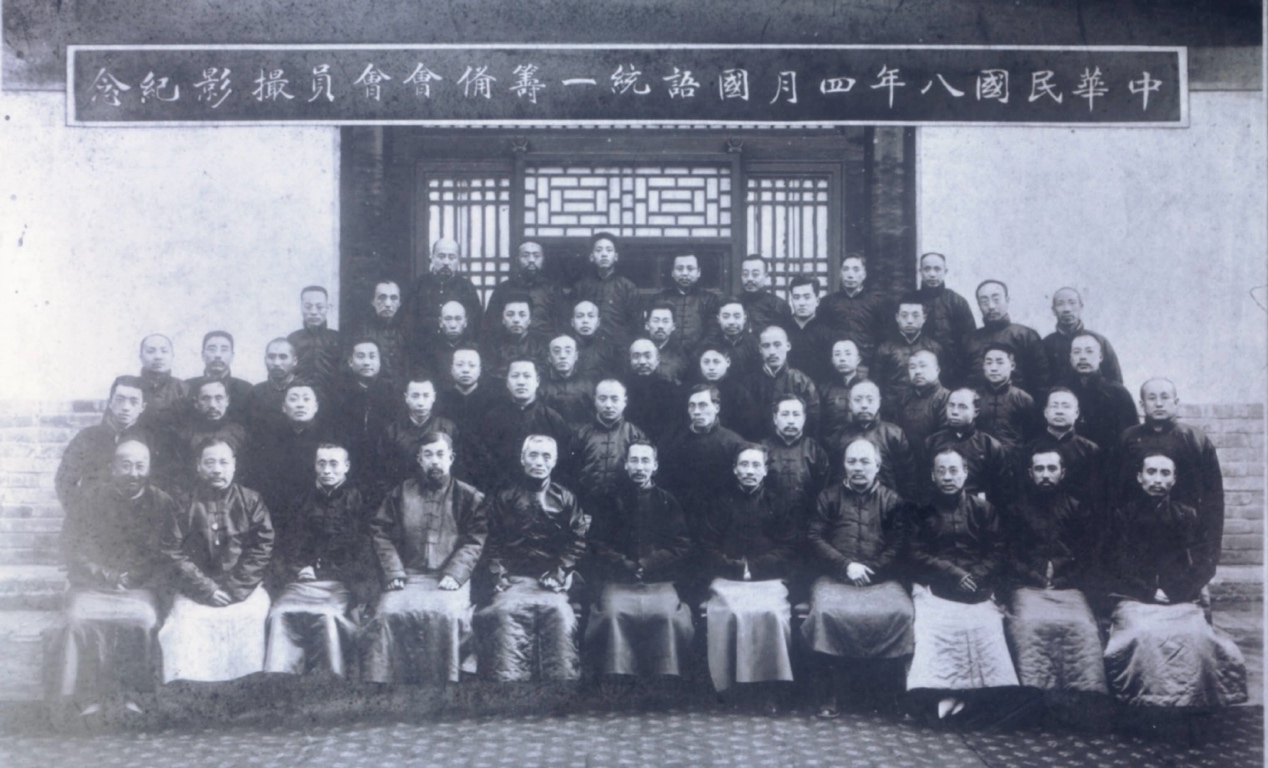
This is a group photo taken on the day the National Language Committee was established. In the front row, from left: 4th is Yuan Xitao, 5th is Zhang Yilin, 6th is Zhu Wenxiong, 7th is Cai Yuanpei, 8th is Wu Zhihui, 9th is Li Buqing, 10th is Zhu Xizu; Second row, from left: 1st is Hu Shi, 5th is Wang Yi, 9th is Zhou Zuoren; Third row, from left: 5th is Qian Xuantong, 6th is Qian Daosun, 10th is Li Jinxi; Fourth row, from left: 4th is Liu Bannong; 9th is Li Jinhui, 10th is Wang Pu.
References:
The Kuomintang Elder: Wu Zhihui, by Lu Xiaoke, Lanzhou University Press, April 1997.
Wu Zhihui and the National Language Movement, by Zhan Wei, Wenshizhe Publishing House, April 1992.
Outline of the History of the National Language Movement, by Li Jinxi, The Commercial Press, May 2011.
June 15, 2026, in Beijing