
Wang Zhengfang's Articles in Guoyu Xiaobao
Author: Peter Wang
Wang Zhengfang (Peter Wang, also known as “Director Wang”) returned to Beiping with his parents from the wartime rear after the Japanese surrender, and enrolled at the Second Affiliated Primary School of the Normal College (now Beijing No. 2 Experimental Primary School). Between 1947 and 1948, while in the fourth grade, he published a series of short pieces in Guoyu Xiaobao (the National Language Children’s Paper) covering family life, school, observations and reflections. The writing is plain and earnest — a vivid sample of how Beiping schoolchildren of the period wrote in vernacular, phonetically annotated Mandarin. His elder brother, Wang Zhengzhong, also contributed many pieces to the same paper during this period. Below are five of Wang Zhengfang’s pieces, plus one by Wang Zhengzhong.
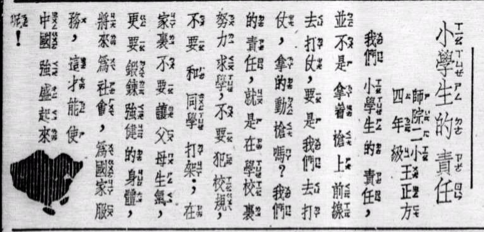
A Schoolchild’s Duty — October 19, 1947
The duty of us schoolchildren is not to take up rifles and go to the front lines to fight; if we did go to fight, could we even hold a rifle? Our duty is to study hard at school; not to break school rules; not to fight with classmates; not to anger our parents at home; and to train our bodies to be strong, so that in the future we can serve society and the nation — only then can China grow strong!
— Wang Zhengfang, Grade 4, Second Affiliated Primary School of the Normal College
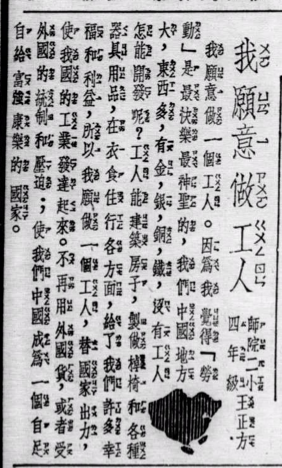
I Want to Be a Worker — October 28, 1947
I want to be a worker. Because I feel that “labor” is the happiest and most sacred thing. Our China is vast, with abundant things — gold, silver, copper, iron — without workers, how can these be developed? Workers can build houses, manufacture machines and all kinds of industrial goods, providing us with much happiness and benefit in food, clothing, shelter, and transport. So I want to be a worker, to contribute to my country, and to help our nation’s industry flourish — so we no longer have to use foreign goods, or be controlled and oppressed by foreigners; so that our China becomes a self-sufficient, prosperous, and happy country.
— Wang Zhengfang, Grade 4, Second Affiliated Primary School of the Normal College
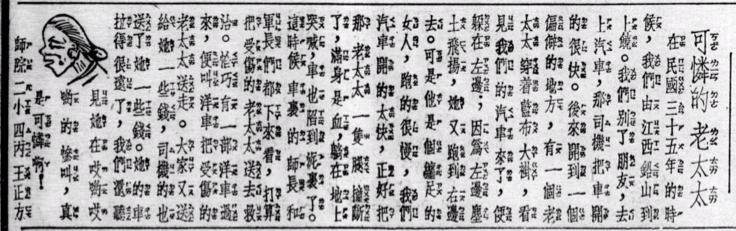
The Pitiful Old Lady — November 7, 1947
In the 35th year of the Republic (1946), we traveled from Yanshan in Jiangxi to Shangrao. After saying goodbye to our friends, we boarded a car. The driver drove very fast. Later we came to a remote stretch of road, where an old lady in a blue cloth gown saw our car coming and dodged to the left side; because dust was flying on the left, she ran back to the right. But she had bound feet and could not run quickly. Our car was going too fast, and one of her legs was broken in the collision. She was covered in blood, lying on the ground crying out. The car had also gotten stuck in the mud. The army officers all got out to look, intending to send the injured woman for treatment. By chance a rickshaw came by, and they had it carry her away. Everyone gave her some money, and the driver gave her some money too. Long after the rickshaw had gone far away, we could still hear her sighing and crying out in pain — truly pitiful!
— Wang Zhengfang, Class 4-Bing, Second Affiliated Primary School of the Normal College
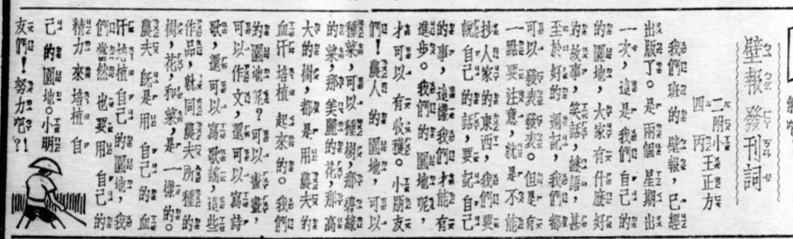
Inaugural Note for the Wall Newspaper — March 16, 1948
Our class wall newspaper has been published. It comes out once every two weeks. This is our own little garden — anyone with a good story, joke, riddle, or even a good weekly journal can publish it here. But there is one thing to keep in mind: we mustn’t copy from others. We have to speak in our own words and write about our own affairs — only then can we make progress, only then can our garden bear fruit. Children! The farmer’s garden grows vegetables and trees; those green vegetables, those beautiful flowers, those tall trees — all are nurtured by the farmer’s blood and sweat. And our garden? We can draw, we can write essays, we can write poems and ballads — and these works are like the trees, flowers, and vegetables the farmer grows. Just as the farmer nurtures his garden with his own blood and sweat, we too must use our own efforts to cultivate our garden. Children — work hard!
— Wang Zhengfang, Class 4-Bing, Second Affiliated Primary School
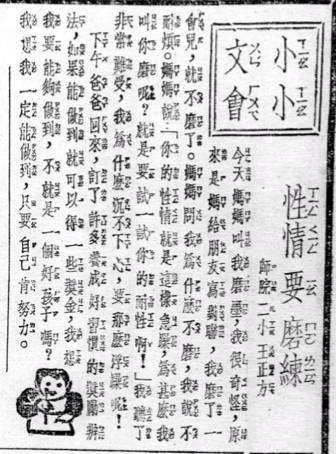
Tempering One’s Temperament — June 1, 1948 (Guoyu Xiaobao, page 4)
Today Mama asked me to grind ink. I was puzzled — it turned out she was writing couplets for a friend. I ground for a while, then stopped. Mama asked why I had stopped. I said I was impatient. Mama said: “Your temperament is exactly this impatient. Why did I ask you to grind? Precisely to test your patience!” I felt awful hearing this — why couldn’t I settle down, why was I so restless?
In the afternoon, when Papa came home, he set up many reward rules for forming good habits — if I could keep them, I would earn some prize money. I thought: if I can do it, won’t I be a good child? I’m sure I can do it, as long as I work hard.
— Wang Zhengfang, Grade 4, Second Affiliated Primary School of the Normal College
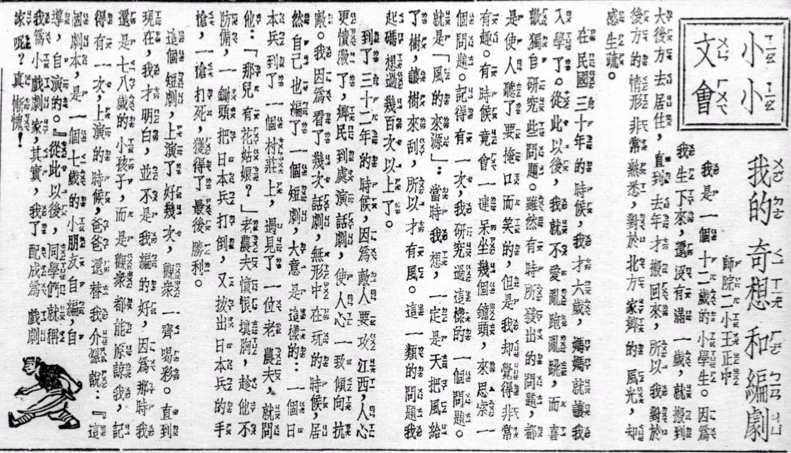
Appendix: A Piece by Wang Zhengzhong — My Wild Ideas and Playwriting — May 28, 1946
I was not yet a year old when I was carried off to the wartime rear, and I did not return to my hometown until our victory in the war last year. So I am very familiar with conditions in the rear, but the scenery of my northern hometown feels strange to me.
In the 30th year of the Republic (1941), I started at the Normal College’s primary school. From then on, I lost interest in physical exercise and instead enjoyed pondering questions on my own. Sometimes the questions I came up with were the kind that would make people cover their mouths and laugh, but I found them very interesting. Sometimes I would sit still for several hours straight, thinking through one question. I remember once I pondered: “Where does wind come from?” At the time I thought: heaven gives the wind to the trees, the trees shake to thank it, and that’s how wind exists. I must have thought through hundreds of questions like this.
By the 32nd year of the Republic (1943), the enemy was about to attack Jiangxi, and people’s hearts grew more indignant. Villagers everywhere put on plays to rally everyone toward resistance. After watching several plays, while playing I unwittingly composed a short play of my own. The plot went like this: a Japanese soldier comes to a village and meets an old farmer. He asks: “Where are the pretty girls?” The old farmer, his heart filled with hatred, catches him off guard — strikes him down with a hoe, snatches the soldier’s pistol, and shoots him dead, winning the final victory.
This little play ran for several days, and the audience cheered together. Only now do I understand: it wasn’t that I wrote it well, but that I was a seven- or eight-year-old child at the time, and the audience was being generous. I remember once, before a performance, Papa even introduced it: “This script was written, directed, and performed by a seven-year-old.” From then on my classmates called me “the little playwright.” But honestly, how could I deserve to be called a playwright? I’m truly embarrassed!
— Wang Zhengzhong, Second Affiliated Primary School of the Normal College
Note: Wang Zhengzhong’s pieces in Guoyu Xiaobao include “The Admirable Gandhi,” “My Wild Ideas and Playwriting,” “Precious Air,” “The Frightening Military Truck,” “Our School’s Sports Day,” “Winter Vacation Life,” “Thoughts on Children’s Education,” “Self-Strengthening and Self-Abandonment,” “A Page from My Diary,” “Street Notes,” “Minutes of the Self-Government Meeting,” “Folk Songs,” “A Day’s Diary,” “A Letter,” “My Speech,” “An Intelligence Test,” “Folk Songs from Various Places,” “I Want to Meet Chairman Chiang,” “The Greedy Old Woman,” and “Why Do Dogs Bite Cats on Sight?”