
Zhao Yuanren: The Master Accomplished by His Wife
Author: Yun Wang
The legend of Zhao Yuanren lies in his lineage as a descendant of Zhao Kuangyin, in the numerous degrees he earned across different disciplines from prestigious American universities, in being the youngest among the “Four Great Mentors” of Tsinghua University during the Republic of China, and in his remarkable talent for linguistics and music. However, it lies even more in his extraordinary wife, Yang Buwei, whose influence seems to be behind every one of his achievements. One instance illustrating her impact occurred after the victory of the War of Resistance: the Ministry of Education invited Zhao to serve as the President of Central University. Zhao, who usually avoided administrative roles, reluctantly agreed this time. However, Yang Buwei argued strongly against it, and they ultimately decided to remain in the United States. Later, Fu Sinian teasingly scolded Yang: “Every decision is yours! If Yuanren had become the President, wouldn’t it have been you running the show? How wonderful that would have been!”
The meeting of Zhao Yuanren and Yang Buwei actually had a connection to the Preparatory Committee for the Unification of the National Language (later referred to as the “National Language Commission”). On September 18, 1920, Zhao, as a member of the commission, attended a meeting in Beijing. Since the meeting ended late at 7 PM and the Xizhimen city gates were already closed, he couldn’t return to Tsinghua. Instead, he went to the home of his cousin Pang Dunmin at Xiangfang Bridge. Pang Dunmin and his cousin Feng Zhiwen were hosting guests, one of whom was Yang Buwei. This was their first meeting. Yang’s impression of Zhao was: “Suddenly, an unknown student returned from America walked in, smiling at us without saying much…” Because of this encounter, Zhao settled a long-standing arranged marriage at great cost, while Yang gave up her newly established Senren Hospital. This marriage proved to be profoundly influential for both.
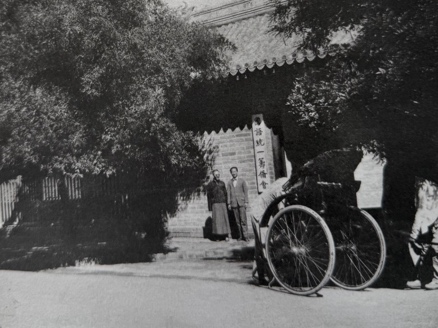
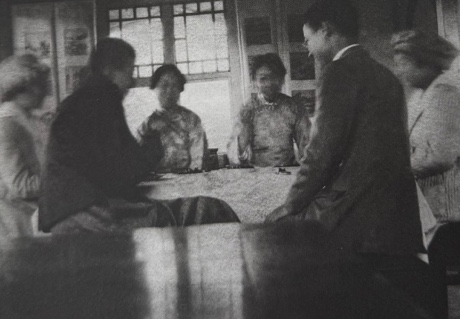
(Left: Zhao Yuanren in front of the National Language Commission gate; Right: Zhao Yuanren (second from right) meets Yang Buwei (first from right) for the first time at Pang Dunmin’s house)
Zhao Yuanren is regarded as a world-class linguistic master. His contributions to the National Language Movement primarily focused on three areas: first, the establishment and promotion of National Pronunciation through gramophone records; second, the creation of Gwoyeu Romatzyh (GR); and third, extensive dialect surveys and the production of numerous valuable reports. All three endeavors received full support and participation from Yang Buwei.
National Language on Records
Zhao Yuanren and Yang Buwei married on June 1, 1921. At that time, Zhao was rushing to complete the first set of National Language records. They used their honeymoon as an excuse to keep everyone away, except for Hu Shi, who came to discuss the records. In August, they hurriedly left for the United States, facing financial uncertainty and hardship. To afford the trip to New York to record the records, Yang Buwei took three fox furs she had brought from home to a pawnshop in Cambridge’s Chinatown and exchanged them for $45, covering Zhao’s travel expenses. To save time and money, Zhao traveled to New York by boat, completing the recording of the first set of National Language gramophone records and fulfilling his contract with the Commercial Press.
The standard pronunciation adopted by vote in the 1913 “Commission on the Unification of Pronunciation” was based primarily on Beijing sounds while incorporating regional pronunciations from the south, creating a composite “Mandarin” that mixed north and south. This was China’s first unified national pronunciation standard. In 1922, Zhao’s “National Language Gramophone Records Textbook (Category B, with Explanations)” was published. It is said that only Zhao could have mastered that blend of northern and southern pronunciations, making him the pioneer in promoting pronunciation through audio records. These records became essential materials for studying pronunciation at the time. In his diary on January 17, 1924, Qian Xuantong recorded: “At 9:30, after eating cat meat, I returned to Shen (i.e. Shen Shiyuan)’s residence and invited Bu’an (i.e. Shan Bu’an) to listen to Zhao Yuanren’s ‘talking box’ (phonograph).” By 1928, Zhao had recorded over 2,000 discs. Although the “Old National Pronunciation” eventually faded into history, it was a pioneering attempt in the National Language Movement, and Zhao’s preserved voice holds immense historical value. (The following is an excerpt from the textbook)
“Zhen Guoyu and Jia Guanhua” Old National Pronunciation Original Recording:
Zhen Guoyu and Jia Guanhua (Zhen Guoyu, a homophone for “True National Language”; Jia Guanhua, a homophone for “Fake Mandarin”)
(From Zhao Yuanren’s “National Language Gramophone Records Textbook”, 1922)
This lesson compares National Pronunciation with Beijing Pronunciation. Zhen Guoyu speaks the Old National Pronunciation, while Jia Guanhua speaks Beijing Pronunciation.
Zhen Guoyu: May I ask your surname?
Jia Guanhua: My surname is Jia. And yours, sir?
Zhen: My surname is Zhen.
Jia: Have you been in the north for many years?
Zhen: No, I’ve only been in Beijing for six months.
Jia: Only six months? Are you perhaps from Nanjing? Your speech sounds a bit like a Nanjing accent.
Zhen: No, I am from Shanghai. I am speaking the National Language.
Jia: Ha! You mean this is the National Language? I heard they recently invented a ‘National Language.’ What is it used for?
Zhen: The National Language is a tongue intended for use across the entire country.
Jia: Then, is the National Language just another name for Putonghua (Common Speech)?
Zhen: No, the term ‘Putonghua’ is interpreted differently by everyone. Generally, if someone has traveled through several provinces and their tongue isn’t very agile, they claim they can speak ‘Putonghua.’ Sometimes it’s a mix of southern and northern accents—harder to understand than a local dialect.
Jia: Then why not just have everyone learn Beijing speech? There are already over a million people here in Beijing speaking it right now. Wouldn’t it be easier if their speech was simply declared the National Language?
Zhen: There is truth in that. But you must understand that the National Language is a highly regular system, a practical common tongue. In fact, Beijing speech and the National Language differ by only about five percent. For instance, in the National Language, we distinguish ‘blood’ (xyue5) from ‘snow’ (syue5). We in Jiangsu Province distinguish them clearly. If we were forced to say ‘blood’ (xuě) and ‘snow’ (xuě) exactly like in Beijing, wouldn’t we be learning to speak worse?
Jia: Hah! So Jiangsu Mandarin is superior to Beijing Mandarin!
Zhen: Not at all! Every region has its strengths. For example, in the National Language, we say, ‘This person wasn’t poisoned to death (yo5), he was destined to die (yau4).’ The distinction between ‘poison’ and ‘destiny’ is very clear in Sichuan, Hubei, and Hunan. If one must say them both the same as in Beijing, isn’t that ‘aiming for the middle and hitting the bottom’?
Jia: Hmph! So Beijing Mandarin has fallen to the level of a ‘mediocre’ National Language!
Zhen: Mr. Jia, don’t take offense. Didn’t I say Beijing speech is already a 95-point National Language? A standard National Language is like a teacher. A teacher must score 100 to be qualified. But a student only needs to pass. Isn’t anything over 85 considered excellent? Thus, the 95-point National Language of Beijing far surpasses the failing National Language of my home province, Jiangsu!
Jia: Haha! That’s a bargain then. We in Beijing are already ‘graduates’ of the National Language by over a million, without even going to school. Not only graduates without studying, but ‘excellent’ ones at that!
Zhen: Quite right! Beijing indeed has a million ‘excellent’ graduates who never had to study the National Language!
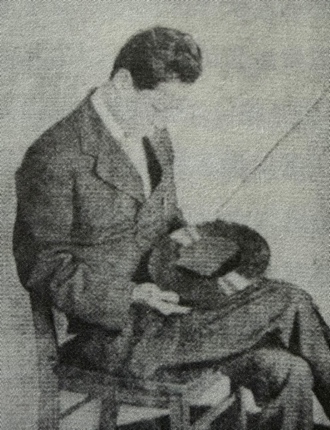
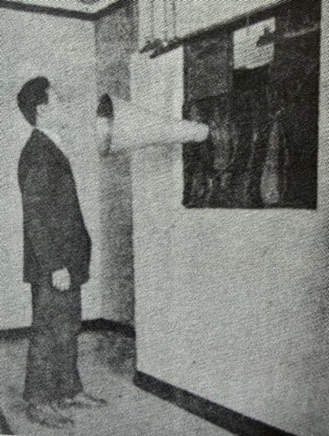
(Zhao Yuanren recording in New York)
Later, Zhao’s “International Phonetic Alphabet National Pronunciation Dictionary” was published in November 1926 by the Commercial Press. This was a reference book that used his phonetic tables to provide standard pronunciations for 10,000 common Chinese characters. In February 1935, his “New National Language Gramophone Records Textbook” was released, featuring much richer content, including instructions on using the phonograph, Sun Yat-sen’s testament, the party song, labor songs, nursery rhymes, and poems by Hu Shi. This period of dominance in the field lasted until the publication of Bai Dizhou’s records.
“National Phonetic Alphabet Song” Original Recording:
Regarding the influence of Zhao’s records, there is a memorable anecdote. In early 1938, as the Institute of History and Philology (IHP) moved south through Guilin, Guangxi, the massive number of refugees meant they were stranded, waiting for the provincial government to allocate vehicles. Zhao and others were forced to stay in a meager hotel used by cart drivers. To leverage Zhao’s influence, he was persuaded to meet with the Provincial Chairman, Huang Xuchu. To his surprise, upon meeting, Huang said, “Mr. Zhao, every day before I start work, I always have a chat with you before going to the office.” Confused, Zhao followed him into a lounge, only to burst into laughter. There, by Huang’s bed, was a set of Zhao’s National Language records, with one still spinning on the machine. Huang stopped the machine, listened to Zhao’s request, and all their transportation problems were immediately resolved. Zhao’s records had an immense impact at the time and remain a delight to listen to even today.
The Invention of Gwoyeu Romatzyh
The “Society of a Handful of Men” (Shu-ren Society), which invented Gwoyeu Romatzyh, was a spontaneous academic organization founded by Zhao Yuanren, Qian Xuantong, Liu Bannong, Li Jinxi, Lin Yutang, and Wang Yi. Their office was located in a birth control clinic opened by Yang Buwei. At the time, Zhao was a professor at Tsinghua, and Yang was actively involved in various community services. Later, she and many other professors’ wives expressed a need for birth control. As a medical doctor supported by Hu Shi and Jiang Menglin, Yang raised funds to open a clinic dedicated to what is now known as family planning. She chose a traditional three-courtyard house on Jingshan East Street. The first courtyard served as the clinic, while the second became the meeting place for Zhao and his colleagues from the National Language Commission. There, they ate, talked, and eventually formed the “Society of a Handful of Men,” a name derived from a line in the preface of Qieyun: “A handful of us can surely settle it.” Many of the 22 meetings following the society’s founding on September 26, 1925, were held there. Yang recalled that Qian Xuantong loved to talk incessantly there, swaying with excitement; Hu Shi would occasionally visit; and Wang Guowei had intended to join but died before he could formally do soNote 1.
During the “March 18th Massacre” in 1926, the clinic faced constant trouble from the police because it had aided injured students. The authorities claimed their work in “reducing the population” was rebellious and found the society’s name suspicious. Yang was eventually forced to close the clinic. However, the society managed to complete the “Gwoyeu Romatzyh Phonetic System” and submitted it to the Ministry of Education. The National Language Commission approved the scheme on September 14, 1926, and officially announced it to the public.
While Liu Bannong proposed the formation of the society, the GR scheme was primarily Zhao’s work. As early as 1920, he had shared his views on phonetic scripts for Chinese with friends: “First, China must be unified before phonetic scripts can be exclusively adopted; second, the ambiguity of phonetic scripts can be offset by using polysyllabic word forms — most spoken dialects already tend toward polysyllabic expressions; third, the phonetic system can be applied to complex academic and scientific domains, especially for transliterating foreign words in science.” His diaries reveal his thought process: January 12, 1926, drafting rules for Romanization; 13th, writing explanations and phonetic notations for common characters; 14th, completing the table of finals; 15th, researching pre-phonetic symbols; 16th, studying the vowel table; 30th, working on the GR booklet at home; February 4th, gathering all GR materials.
Meanwhile, Yang Buwei was actively involved in the National Language Commission’s various activities. Qian Xuantong’s diary records: July 7, 1925: “Yesterday, together with Chen Songping (i.e. Chen Maozhi), Li Shaoxi (i.e. Li Jinxi), Wang Yi’an (i.e. Wang Yi), Shen Duoshan, and Lu Yu’an (i.e. Lu Ji) — six of us in total — we arranged to host Zhao Yuanren for lunch today at Changmei Xuan. In the morning I went to the Ministry of Education; at the appointed time we dined; after the meal, his wife, Miss Yang, also came.” October 11: “In the evening, attended Yutang’s (i.e. Lin Yutang) banquet at his home. Seated together were the Yuanren couple and Bannong.” November 15: “At noon went to Xieying, attended the Shu-ren Society meeting chaired by Shaoxi; four present — Zhao, Qian, Lin, Li — plus Mrs. Zhao as well.” January 23, 1926: “Together to Senlong for a meal — Zhao (referring to Zhao Yuanren), Zhao Yi (referring to Yang Buwei), Wang (i.e. Wang Yi), Li (i.e. Li Jinxi), Qian (i.e. Qian Xuantong).” October 5, 1928: “At noon the Zhao Yuanren couple came to visit; they (referring to the aforementioned couple) invited Li and me to eat crabs at Zhengyang Lou.”
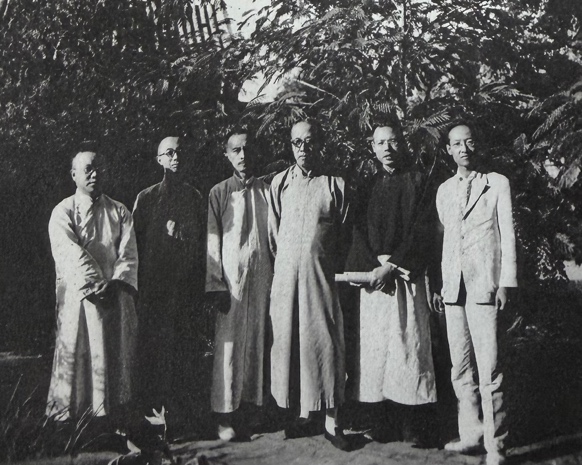
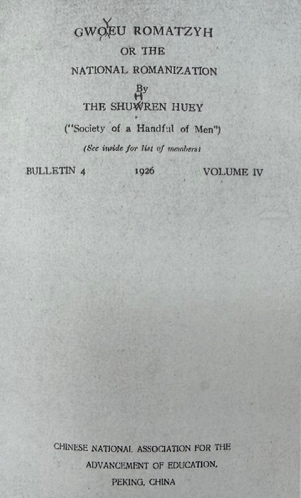
(Left: Qian Xuantong (first from left), Li Jinxi (second from left), Wang Yi (fourth from left), and Zhao Yuanren (first from right); Right: Draft of Gwoyeu Romatzyh Phonetic System)
Investigating Dialects
As the National Language Movement vigorously promoted “National Language Unification,” true linguists recognized the importance of preserving dialects. Having traveled extensively with his family since childhood, Zhao was exceptionally sensitive to the sounds of different speakers. He could distinguish several different dialects upon arriving in Shanghai: rickshaw pullers and laborers mostly spoke Jiangbei dialect, a type of southern Mandarin from the Yangzhou region; Shanghai dialect sounded to him like Changshu dialect, though not as pleasant; and his own family spoke a northern dialect with a Changzhou accent. At 13, after his parents passed away, he was sent to his maternal grandparents in Suzhou, where he learned to play a secret-language game using the fanqie method and developed an interest in English. He could later write out the musical scores of dialect children’s songs from memory.
In October 1927, he set out to investigate dialects in Jiangsu and Zhejiang. At the time, Yang Buwei was busy rehearsing plays at Tsinghua. Feeling she was too restless on campus, Zhao took her south with him. During this trip, Zhao completed “Studies in the Modern Wu Dialects,” while Yang sampled local delicacies everywhere, laying the groundwork for her later book “How to Cook and Eat in Chinese.” In the summer of 1928, Fu Sinian, who was organizing the IHP, invited Zhao to investigate dialects in Guangdong and Guangxi. Worried that civil war might resume and sever north-south transportation, the pregnant Yang Buwei first brought their two children to Shanghai to settle them, then accompanied Zhao to Guangdong once again. By then, Zhao could speak 33 dialects and could even learn a new one in a single week. He later completed books such as “Phonetic Transcriptions of Guangxi Yao Songs,” which were published in succession. During this period, they stayed at Fu Sinian’s home for 40 days; because of Yang Buwei’s presence, Fu joked that she had “eaten him into poverty.”
After formally joining the IHP, Zhao investigated dialects in Anhui. Yang not only accompanied him but also achieved a remarkable feat — climbing the “Carp’s Back” of Huangshan Mountain, a spot “no woman had ever reached” before. Later, due to a move, Zhao went alone to investigate dialects in Jiangxi, Hubei, and Hunan, eventually falling ill in Ganzhou. Upon receiving a telegram, Yang rushed there by boat. When she disembarked at Jiujiang, Zhao had already recovered and actually came to meet her — which gave Yang the unexpected opportunity to visit Jingdezhen, the famous porcelain capital. In 1938, after moving with his family and the IHP to Yunnan, Zhao completed the “Report on a Survey of the Dialects of Hubei” during a brief rest period.
Friendships
Zhao Yuanren’s interactions with his friends were inseparable from Yang Buwei’s presence. The following highlights only three individuals closely connected to the National Language Movement.
Zhao and Hu Shi were classmates during their studies in the U.S. and remained very close. Zhao’s first translated work, Alice’s Adventures in Wonderland, was given its Chinese title by Hu Shi. In 1916, they jointly published an article on “The Problem of the Chinese Language” in The Chinese Students’ Monthly. Hu Shi once recalled: “Zhao Yuanren often came to my house to have long talks about phonology and Romanization; we did this often back at Cornell.” Hu Shi recorded the scene of Zhao and Yang’s wedding in great detail: “One day, Yuanren called me and asked if I had time to come to 49 Xiaoyabao Hutong the next evening, to have dinner with him, Miss Yang, and another friend, Miss Zhu Chunguo (Chunkuo, the courtesy name of his cousin Zhu Zheng). There were no restaurants or clubs in that part of the city, so I guessed what was going on. To be prepared, I brought a copy of Dream of the Red Chamber with my annotations, wrapped like a gift. In case I was wrong, I added an outer layer of plain paper. That evening, the four of us sat in a small, elegant dwelling and enjoyed a refined dinner of four delicious dishes, all prepared by Miss Yang herself. After tea, Yuanren produced a handwritten document and said that if Dr. Zhu and I would be willing to sign as witnesses, he and Yunqing (i.e. Yang Buwei) would be greatly honored. And so Zhao Yuanren and Yang Buwei were married. I was the first person to give them a wedding gift.” Afterward, Hu Shi sent the news to the Morning Post, and the next day a report titled “A New-Style Wedding of New Figures” caused quite a sensation, leaving the newlyweds busy entertaining guests. Shortly after, the Zhao couple departed for the United States. When Hu Shi saw them off in Shanghai and noticed Yang’s unusual lethargy, he said: “Yunqing, I think you have a special reason — try drinking some soda, it might settle your stomach.” Being a man of experience, he diagnosed her pregnancy before the doctor herself had realized it.
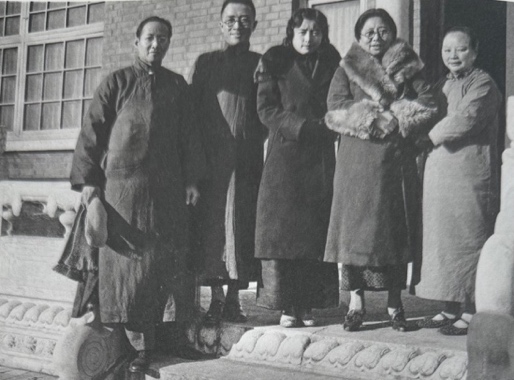
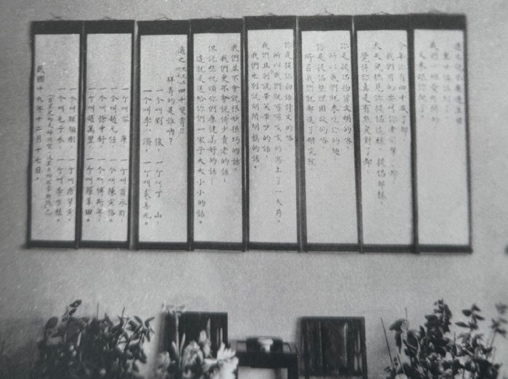
(Left: The Zhao and Hu families at Hu Shi’s home in Beijing; Right: Zhao Yuanren’s poem for Hu Shi’s birthday hanging on Hu’s wall)
Hu Shi deeply admired Zhao’s talent. In his preface to Zhao’s 1922 records, he wrote: “If we are to use gramophone records to teach National Pronunciation, no one in all of China is more qualified for this task than Mr. Zhao Yuanren.” Zhao reciprocated this respect, including Hu Shi’s poems “Him” and “Optimist” as reading samples in his “New National Language Gramophone Records Textbook,” having received special permission to cite Hu Shi’s works.
Lesson 15: Reading Poetry
“Him” by Hu Shi
You love him in your heart — don’t say you don’t.
To see if you love him, wait until someone harms him.
If someone harms him, how would you treat him?
If someone loves him, how then would you treat him?
It should be said that Hu Shi was also very fond of Yang Buwei’s straightforward and candid nature. When Yang and Zhao wrote to Hu Shi after passing through his hometown of She County, praising it as “a place of beautiful mountains and clear waters — it is precisely this kind of good feng shui that produced a person like you,” Hu Shi wrote back to Yang delightedly: “Yunqing, I want to kiss you a hundred times — thank you!” — his joy spilling over. In the summer of 1939, when Zhao was relocating, he drove the entire family from the west coast to the east coast of the United States, sightseeing along the way for a total of 18 days. When Hu Shi found out, he gave Yang a severe scolding, saying she only cared about having fun without considering the danger of making Zhao drive such a long distance. Yang could only smile and dared not retort, because she understood Hu Shi’s deep affection for Zhao.
While Zhao and Hu Shi were dear friends from their student days, Zhao and Liu Bannong shared a deep intellectual bond between kindred talents. When Zhao and Yang first traveled to Europe, Liu Bannong was studying at the University of Paris, and his family, in financial difficulty, rarely ventured out. During the period when Liu was preparing for his doctoral defense, the Zhaos visited the Liu family almost daily, always bringing food along, and the busy Zhao and Liu made use of mealtimes for their exchanges. On the day of Liu’s doctoral oral examination, it was thanks to the Zhaos bringing a camera and being permitted to secretly photograph him that a permanent memento was preserved. The defense lasted a full six hours; when it was over, Liu propped his head in both hands on the table, utterly exhausted.
Liu Bannong was a famous writer of the “Mandarin Ducks and Butterflies” school and collaborated with Zhao on many songs, the most famous being “How Can I Stop Thinking of Him,” which remains a classic today. Most people know this song as Zhao Yuanren’s work, yet few realize that the lyricist was Liu Bannong. In their interactions, there were moments when even Liu could not cope. Once, when Liu was collecting curse words for research, Zhao showed up at his door and cursed at him for two hours straight in Hunan dialect, Sichuan dialect, and Anhui dialect, leaving Liu unable to retort and frantically taking notes.
When Liu passed away prematurely in 1934, Zhao’s elegiac couplet expressed his grief: “Ten years as a duo, it’s hard to compose without lyrics now; one is missing from our handful — how can I stop thinking of him!”
Zhao’s relationship with Qian Xuantong was purely academic, a bond between kindred scholars. On questions of ancient Chinese phonology, Zhao regarded Qian as a teacher and frequently sought his advice. On December 4, 1935, from the IHP at Beiji Pavilion in Nanjing, Zhao wrote to Qian inquiring about fanqie characters in Karlgren’s research on Chinese phonology that were absent from the Guangyun; on March 18, 1936, he wrote again asking about Karlgren’s upper-qie issues. They also discussed in letters such matters as the pronunciation on Lao She’s gramophone records, Lu Ji’s Suzhou phonetic notation booklet, and textbooks from the Kongde School. Qian would carefully answer Zhao’s questions. On November 7, 1935, Qian wrote to Zhao saying he had been ill for a year and too lazy to write, but having heard Zhao’s National Pronunciation broadcast and noticing that his fifth lecture on “three-spelling” used Wang Zhao’s old method, he felt it was improper and urgently informed him. He also wrote lengthy letters to Zhao discussing the issue of incorporating Suzhou pronunciation into the National Language. He lamented: “Now we strive on one hand to promote a universal National Language for the entire country, and on the other hope for the free development of each dialect — such is the difference between ancient and modern times.” They were indeed of one mind. The closeness between Qian and Zhao was also reflected in how they addressed each other in letters — both used “Di-a”Note 2 (a transliteration of “Dear”). Qian would even confide his troubles to Zhao, writing: “There are sick people in my family — not only my wife but also my children; I myself suffer from ‘zhu-xia’Note 3, and my brush is worn to a stump.”
There is an amusing story about Yang Buwei. Once, Qian Xuantong came to Yang’s clinic looking very anxious, stammering and pacing for a long time before finally blurting out that his wife was dying. In fact, it was a gynecological condition, and his wife refused to see a doctor. Yang said that some rest might help, but Qian insisted it would not, adding that although he and his wife had married without love, she was after all a companion of many years. Everyone had a good laugh; Li Jinxi said he might as well be buried alive alongside her. Yang adapted a mourning poem she had been reading and presented it to Qian: “This mourning is not bound by love — respectful as guests for twenty years; not many partings, not much joy — looking back on today, tears flow unceasing.” Li Jinxi roared with laughter; Liu Bannong scolded Yang, saying she deserved a beating; and Qian actually took the poem home to show his wife. Not long after, Yang ran into the Qian couple in Central Park, and Qian introduced her to his wife, much to Yang’s embarrassment. This little episode perfectly illustrates the relationship between Zhao’s scholarly companions and Yang Buwei.
Undoubtedly, Zhao’s success was first rooted in his natural talent. At 18, he ranked 2nd in the national exams for the Boxer Indemnity Scholarship (Hu Shi ranked 55th). He majored in mathematics at Cornell, later earned a PhD in philosophy from Harvard, and served as a physics professor at Cornell. He possessed an innate sensitivity to sound and developed a keen interest in linguistics during his college years. After taking Professor Davidson’s phonetics course, he felt “a whole new world opened up for his ears.” At Harvard, after taking Professor Charles H. Grandgent’s introductory course in speech, he wrote a basic English textbook and recorded a set of audio discs in a non-American accent. He also learned various Chinese dialects from Chinese friends at Harvard and MIT. When he first taught in the United States, he maintained his passion for language, serving as editor of the Chinese-language Science monthly and writing articles explaining the relationship between Chinese National Phonetic Symbols and the sounds of Eastern languages.
However, it is undeniable that after their marriage, Yang Buwei’s influence on him was immense. Although she no longer practiced as a doctor, she was far from merely a housewife tending to husband and children — she became the family’s primary decision-maker. In 1921, the couple departed for America right after their wedding. In Yang’s words: “First, he thought a change of scenery might do me good, since he could see how distressed I was about closing the hospital. Second, he had been planning to go to America again to study linguistics.” In the first month of 1924, Zhang Pengchun wrote to say that Tsinghua had decided to establish a research institute and intended to appoint four great professors — Liang Qichao, Wang Guowei, Zhao Yuanren, and Chen Yinke — and they absolutely needed Zhao’s acceptance. Yang Buwei said: “If you won’t accept, Yuanren, then I will accept for you.” So they first traveled through Europe for a year before returning to Tsinghua. In August 1937, with the formal evacuation of Nanjing not yet underway and Zhao ill, Yang managed to get him and their eldest daughter out of Nanjing ahead of time because she couldn’t obtain boat tickets for the whole family. Before their departure, she instructed her eldest daughter: if anything happened to her and the other children, take your father to Honolulu. They later reunited in Changsha, but before long, Japanese planes followed there too, and the members of Academia Sinica took shelter in the basement of the Bible College. Zhao exclaimed to Jiang Menglin: “Don’t put all eggheads in one basement!” — if a bomb dropped, the entire academic community would be wiped out. On January 12, 1938, the IHP set out from Changsha, retreating westward through Vietnam to Kunming. Kunming was small, crowded, and rife with disputes; the IHP linguistics division was sidelined, and everyone was demoralized. Zhao would often sit for seven or eight hours holding a pen without writing a single word, going entire days without speaking. Yang realized that “if we don’t leave, it may cause limitless damage to Yuanren’s spirit in the future.” And so they hastily left Yunnan for Honolulu. They were widely criticized at the time, accused of fleeing in the face of danger. A year later, Zhao joined Yale University to teach and compile dictionaries — at that time, the center of linguistics in America was at Yale.
After the war, the Zhao couple had originally planned to return to China. In August 1947, Minister of Education Zhu Liuxian sent a telegram inviting Zhao to return as President of Central University. At that time, Hu Shi headed Peking University and Mei Yiqi headed Tsinghua; Zhao declined repeatedly but began to waver. The telegram then reached Yang Buwei. Knowing Zhao disliked administrative duties, she told him to stay in America for the time being to avoid the matter. By then Zhao had already resigned from all his American positions. Yang recalled that the University of California had once invited him and thought they could try again. This decision shaped the rest of Zhao’s life — they eventually settled in California and lived out their years there.
Yang Buwei had her own wisdom. On the eve of the War of Resistance, after Hu Shi, Jiang Menglin, Mei Yiqi, and other prominent intellectuals attended Chiang Kai-shek’s Lushan Conference and came to Nanjing, Yang received a telegram from the three men’s wives in Beiping, asking her to keep them from returning north. Hu Shi was eager to go back to calm people’s nerves, but Yang, relying on her own judgment, believed they must not return to Beiping. She said: “If they are captured by the Japanese, it would benefit neither themselves nor the nation’s cause in the slightest.” Her judgment later proved entirely correct.
Zhao spent the rest of his life in America engaged in linguistic work — teaching Chinese, writing monographs, and participating in linguistics organizations. During World War II, he directed the Chinese language program at Harvard, training many American sinologists. He served as a drafter of UNESCO’s guidelines and as president of the Linguistic Society of America. He lectured widely on topics ranging from “Language Problems of Chinese Children in America” to “Mixed Metaphors.” He traveled to Taiwan, Japan, and Scandinavia for various academic conferences. Whether in England or Hong Kong, he always paid attention to and investigated the spread and evolution of the National Language. In 1973, he was finally able to return to Beijing, where he met old friends Li Jinxi, beloved students Wang Li and Ding Shengsu, and engaged in academic discussions — yet found they had no interest in the world beyond China, and their thinking was no longer aligned with his. As they visited various places, Zhao noticed that in Shanghai, Guangzhou, and elsewhere, there was mostly only Mandarin on the radio, with little use of dialects remaining.
Thus, Zhao Yuanren lived the life of an international scholar, engaging in teaching and research while enjoying a comfortable life. He could speak with Chiang Kai-shek in Taiwan and was received by Zhou Enlai in mainland China. With four accomplished daughters and sons-in-law, his life was truly one of fulfillment — and the pivot of it all was his wife, Yang Buwei.
Notes:
Note 1: “Something happened to him” refers to Wang Guowei’s suicide by drowning in Kunming Lake.
Note 2: Di-a: Transliteration of the English word “Dear.”
Note 3: Zhu Xia: A Shaoxing dialect term referring to seasonal physical discomfort that occurs in summer and improves when the weather cools.
References:
Reminiscences of the Zhao Family by Yang Buwei, Commercial Press, October 2025.
The Diaries of Zhao Yuanren, Chief Editors Zhou Xinping, Lin Haiqing, Lin Fumei, Commercial Press, October 2022.
The Playful Master: Zhao Yuanren’s Photography, Compiled by Zhao Xinna and Huang Jialin, Commercial Press, 2022.
Autobiography of Zhao Yuanren’s Early Years by Zhao Yuanren, Guangxi Normal University Press, February 2013.
Autobiography of a Chinese Woman by Yang Buwei, Guangxi Normal University Press, June 2014.
The Diaries of Qian Xuantong (Revised Edition), Chief Editor Yang Tianshi, Peking University Press, August 2014.
Beijing, April 10, 2026