
Tsui Chi
Tsui Chi (1909 – October 28, 1950), courtesy name Shaoxi, English name: TSUI CHI.
Tsui Chi’s ancestral home was Yanshan County, Cangzhou, Hebei. He was born in Guangdong and later spent most of his life in Nanchang.
In 1927, he graduated from Xinyuan Middle School in Nanchang and was admitted to the English Department of National Beijing Normal University.
In 1930, he joined the Editorial Office of the Great Dictionary of China as a commissioned editor (Grade B with Grade A treatment).
In 1932, he graduated from National Beijing Normal University and was hired by the Education Department of Jiangxi Province as a secretary.
In the winter of 1937, he was sent by the Jiangxi Education Department to study in the United Kingdom. During his time in Britain, World War II was underway and the economy was difficult. After his official funding ran out, he had to make a living by selling articles and writing for the BBC. During this period, he buried himself in libraries day after day, writing and translating a large number of literary works, and engaging in Sino-British cultural exchange, making lasting contributions to the spread of Chinese culture.
In 1948, he received an appointment as a professor in the History Department of Jiangxi Chung Cheng University, but was unable to take it up due to illness in London.
On October 28, 1950, he died of renal tuberculosis in Oxford, England, and was buried by friends in Botley Cemetery, Oxford. The inscription on his tombstone, “Grave of Mr. Tsui Shaoxi” (崔少溪先生之墓), was written by the modern woman writer Ling Shuhua.
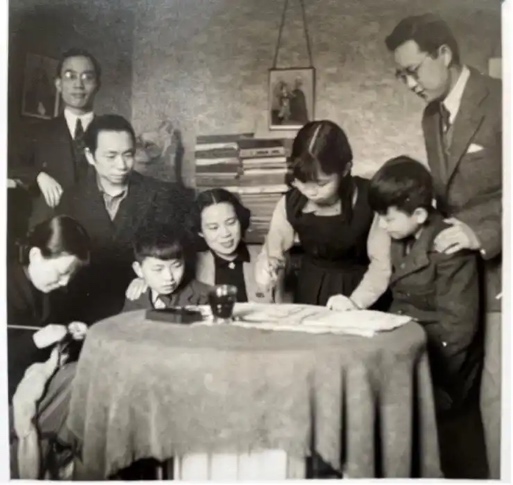
Tsui Chi (first from right) with a friend’s family in England
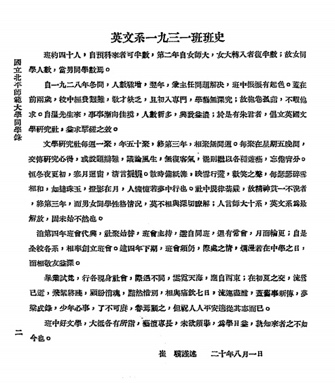
Class history Tsui Chi wrote in his university graduation album
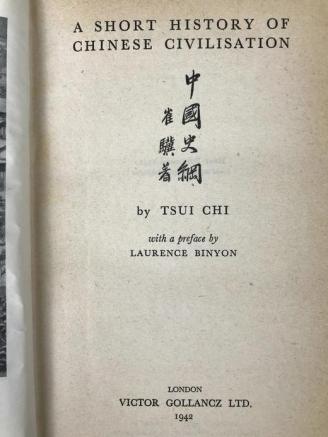
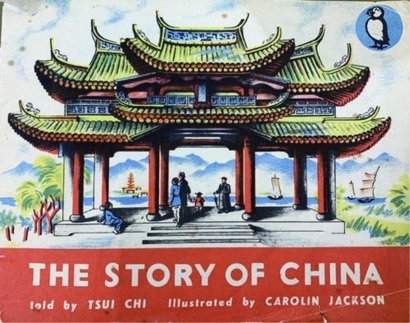
Tsui Chi’s published works in England
Works and Achievements:
Fangyan Kao (A Study of Dialect Sources), five volumes, typeset edition of December 1932, published in Library Science Quarterly, Vol. 6, No. 2. The book catalogues forty-seven specialized works on ancient and modern dialects (most of which had already been collected by the Acquisition Section of the Editorial Office of the Great Dictionary of China), and stands alongside Yaxue Kao and Xuxue Kao.
A Short History of Chinese Civilization, Victor Gollancz Ltd., 1942.
This was the first work on Chinese history written in English by a Chinese author and published in Britain. Its narrative style was mystical and literary, and it sought to lend Chinese civilization a romantic quality. The British poet Laurence Binyon wrote the preface. The renowned British publisher H. G. Wells praised it as the best available reading on Chinese history. The book won acclaim from academic circles in the United States, Britain, and other European countries, and went through many reprints. It was used as a university textbook and translated into German and other languages, becoming one of the rare authentic “Chinese voices” the Western world of that time could hear directly, rather than the prejudice and distortions relayed by Western missionaries or colonial officials.
The Story of China, Puffin Books, 1945.
A children’s book, illustrated by Caroline Jackson. It introduces China to British children in story form, covering history, culture, customs, and folk tales. It also tells the story of how Chinese soldiers and civilians built the Burma Road together, helping British children see China as a country with both an ancient civilization and the modern courage to resist fascism. The book brought knowledge of China to a wider range of British readers.
The Autobiography of a Chinese Girl, translated from the representative work of the Chinese woman writer Xie Bingying, Autobiography of a Female Soldier, Routledge, 1943; by 1948 the book had gone through six printings.
The Golden Year of Fan Cheng-Ta, a collaboration between Tsui Chi and the scholar Bullett translating Fan Chengda’s Sixty Poems on the Four Seasons of Country Life, titled “The Golden Year of Fan Cheng-Ta,” published by Cambridge University Press.
History of Chinese Literature, unfinished.