
Preparatory Committee for the Unification of the National Language
The Preparatory Committee for the Unification of the National Language was established on April 21, 1919, as an administrative agency under the Ministry of Education of the Republic of China, tasked with promoting the National Language. As a government body, it played a pivotal role in advancing the unification of the National Language, with its primary members drawn from the previously established non-governmental organization, the National Language Research Society. The President was Zhang Yilin, and the Vice Presidents were Yuan Xitao and Wu Jingheng. Members included 41 individuals appointed by the Ministry, such as Li Jinxi, Chen Maozhi, Shen Yi, Li Buqing, Lu Ji, Zhu Wenxiong, and Qian Daosun; 35 individuals elected by directly administered schools, including Qian Xuantong, Hu Shi, Liu Fu, Zhou Zuoren, and Ma Yuzao; and 38 individuals subsequently recruited by the committee, including Zhao Yuanren, Wang Yi, Cai Yuanpei, Bai Zhenying, Xiao Jialin, Zeng Yijin, Sun Shiqing, Fang Yi, Shen Jianshi, Li Jinhui, Xu Dishan, Lin Yutang, and Wang Pu.
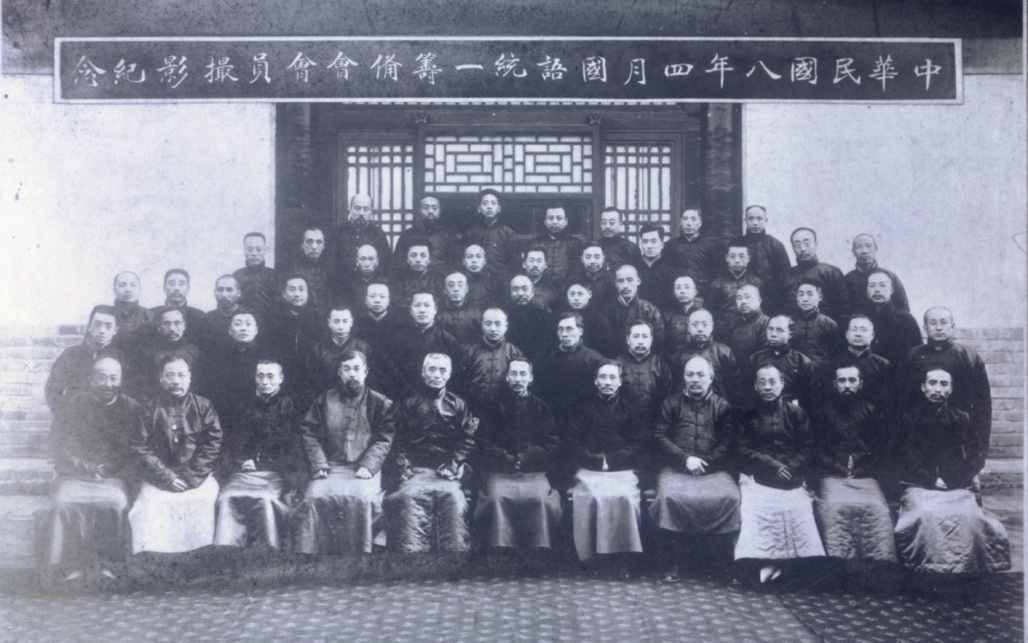
(Group photo on the founding day of the committee. First row from left: 4th is Yuan Xitao, 5th is Zhang Yilin, 7th is Cai Yuanpei, 8th is Wu Zhihui; Second row from left: 1st is Hu Shi, 5th is Wang Yi, 9th is Zhou Zuoren; Third row from left: 5th is Qian Xuantong, 6th is Qian Daosun, 10th is Li Jinxi; Fourth row from left: 4th is Liu Bannong, 9th is Li Jinhui, 10th is Wang Pu)
The primary achievements of this agency included: 1. Promulgating the Zhuyin (Bopomofo) Alphabet (completed during the preparatory phase), establishing their phonetic order, and subsequent revisions; 2. Publishing the “National Pronunciation Dictionary” and “Revised National Pronunciation Dictionary” to establish standard pronunciation; 3. Issuing various directives to rename school language departments from “Chinese Literature” to “National Language,” promoting vernacular Chinese and Zhuyin symbols, establishing inspection and guidance systems with rewards and penalties, and setting up training institutes.
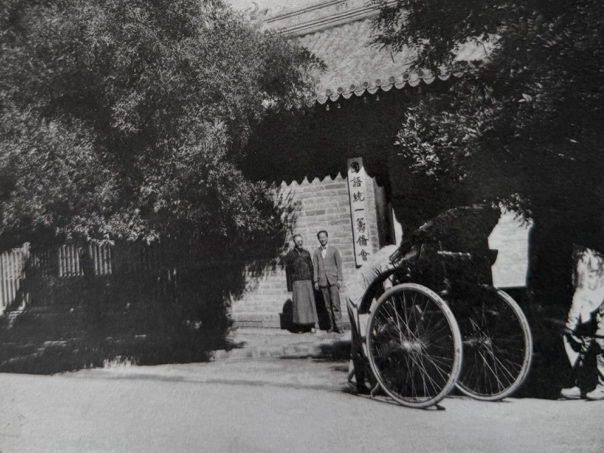
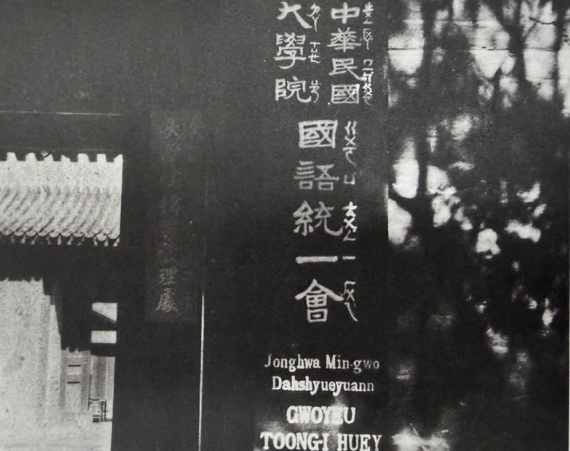
(Left: Entrance of the committee; Right: The committee’s office during the period of the University Institution system, 1927)
In 1928, the Ministry of Education reorganized the agency into the National Language Unification Preparatory Committee, appointing Wu Jingheng as Chairman, with Qian Xuantong, Li Jinxi, Chen Maozhi, Wang Yi, Shen Yi, Bai Zhenying, Wei Jiangong, Zhao Yuanren, and Xiao Jialin as standing committee members. A total of 31 members were appointed: Cai Yuanpei (Jiemin), Zhang Yilin (Zhongren), Wu Jingheng (Zhihui), Li Yuying (Shizeng), Li Shuhua (Runzhang), Qian Xuantong (Yigu), Li Jinxi (Shaoxi), Chen Maozhi (Songping), Wang Yi (Yian), Hu Shi (Shizhi), Liu Fu (Banong), Zhou Zuoren (Qiming), Li Buqing (Lianfang), Shen Yi (Duoshan), Lu Ji (Yu’an), Zhu Wenxiong (Zaowu), Wei Jiangong, Zeng Yijin (Shudu), Sun Shiqing (Huiqing), Fang Yi (Shuyuan), Shen Jianshi, Li Jinhui, Zhao Yuanren, Xu Dishan, Bai Zhenying (Dizhou), Lin Yutang, Ren Hongjun (Shuyong), Ma Tiqian (Ziliang), Qian Daosun, Ma Yuzao (Youyu), and Xiao Jialin (Dichen).
In subsequent work, the committee continued to promote Zhuyin symbols; formulated and advocated for the National Government to publish the “Gwoyeu Romatzyh (National Language Romanization)”; established the Compilation Office of the Great Chinese Dictionary, publishing the “National Pronunciation Commonly Used Word Collection,” which became the first dictionary to standardize National Pronunciation, followed by other important works like the “National Language Dictionary”; published magazines such as “National Language Monthly” for promotion and research; promoted the use of National Pronunciation in telegraphs and station signs with Romanization; advanced the use of National Pronunciation in radio and sound films; proposed promoting National Language education and teaching Zhuyin symbols in primary schools; compiled reading materials and newspapers, designed and cast Zhuyin Chinese character molds for the printing industry; and established the “National Language Literature Museum” to investigate, collect, exhibit, and catalog historical materials of the movement.
In May 1935, the National Language Unification Preparatory Committee was dissolved due to funding issues, and its functions were eventually replaced by the National Language Promotion Committee.