

Li Jinxi, courtesy name Shaoxi
Li Jinxi (February 2, 1890 – March 27, 1978), courtesy name Shaoxi, was born in Xiangtan, Hunan. He was a renowned Chinese linguist, language educator, and lexicographer, and one of the central figures of the National Language Movement.
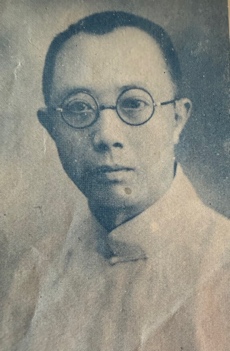
Life and Education
In 1911, Li graduated from the Department of History and Geography of Hunan Higher Normal School. In 1914, together with Yang Huaizhong, Xu Teli, and others, he founded the “Hongwen Book Compilation and Translation Society,” serving as its director and compiling textbooks for primary and secondary schools. In 1915, he served as a specially commissioned textbook compiler at the Ministry of Education in Beijing. From 1920 onward, he was a professor at Beijing Normal University, where he successively held posts as head of the Chinese Department, dean of the College of Arts, and dean of academic affairs. In 1928, 1945, and 1949, he served three separate terms as president of the university. He also held concurrent professorships of Chinese at Beijing Women’s Normal University, Peking University, Yenching University, Hunan University, and Renmin University of China, lecturing on Mandarin grammar, rhetoric, an introduction to script reform, phonology, and modern language studies.
Li devoted nearly seventy years to research and teaching in Chinese linguistics. His research spanned every branch of linguistics, in each of which he attained profound accomplishment. His writings numbered more than seven hundred works (see A Bibliography of Li Jinxi’s Writings, Bibliography and Documents Publishing House, 1996). Three areas were particularly influential: the National Language Movement, the promotion of Mandarin (Putonghua), and Chinese character reform; grammar teaching and research; and dictionary compilation. He also trained a large cohort of linguists, lexicographers, and educators.
Li Jinxi in the National Language Movement
Li Jinxi devoted his entire life to the National Language Movement, the promotion of Mandarin, and Chinese character reform. From 1916 onward, he continually served as one of the most influential initiators, leaders, or organizational members in the movement and in script reform. He was personally involved in every aspect—lecturing, teaching, editing textbooks and dictionaries, designing innovative schemes, writing books and articles, lobbying the government, and supervising local implementation.
- Chinese National Language Research Association: As early as 1916, he and his colleagues organized the “Chinese National Language Research Association,” advocating “unification of the national language” and “consistency between spoken and written language.”
- National Language Unification Preparatory Committee: In 1918, he drafted the “Plan for Advancing National Language Research” as the guiding program of the forthcoming committee. He participated in the revision of Zhuyin Fuhao and, together with Qian Xuantong, proposed that first-grade primary students learn Zhuyin Fuhao. He co-edited the National Language Monthly with Qian Xuantong, and put forward the concept of “conjoined writing of word classes” to overcome the ambiguity of Chinese characters.
- Society of a Few Men and Gwoyeu Romatzyh: In 1926, together with Qian Xuantong, Zhao Yuanren, and other members of the Society of a Few Men, Li drafted the Gwoyeu Romatzyh scheme, formally promulgated by the National Government in 1928—an important step in the romanization of Chinese characters.
- Outline History of the National Language Movement: In 1934, his Outline History of the National Language Movement became a programmatic document of the movement.
- Zhuyin-annotated Chinese characters and Guoyu Xiaobao: In 1935, he promoted the casting of copper type for Zhuyin-annotated Chinese characters, and in 1947 used them to found the Zhuyin-annotated Guoyu Xiaobao (National Language Little News) in Beiping. The paper later moved to Taiwan and was renamed Guoyu Daily, which remains to this day the only Zhuyin-annotated Chinese-character publication in the Chinese-speaking world.
- Guoyu Weekly editions across China: After the outbreak of the war of resistance, he edited the Xi’an, Nanzheng, Chongqing, Lanzhou, and Beiping editions of Guoyu Weekly, working to spread the national language in different regions.
- Chinese Script Reform Association: In February 1949, amid the transition between governments, Li and six others including Wu Yuzhang jointly founded the Chinese Script Reform Association. He served as vice chairman of its standing council and director of the Chinese Character Regularization Committee, continuing the unfinished work of the National Language Movement.
- Hanyu Pinyin and simplified characters: At the request of the new government, he proposed the Scheme for the Chinese Phonetic Alphabet (Hanyu Pinyin), and participated in drafting the simplified character scheme and in promoting Putonghua.
- Later years: During the Cultural Revolution, he persisted in research, creating a “Chinese Double Pinyin” scheme and drafting a number of manuscripts on script reform. On the very day of his death, he was still reviewing the written text of his address to a Beijing regional conference on language standardization.
Grammar Research
Li Jinxi compiled and published New Grammar of the National Language, the first foundational work in China to systematically describe and analyze the grammar of modern Chinese. He rejected the “word-based” grammatical framework and established a “sentence-based” one; in grammatical theory he founded the doctrine of “positions” (wei); he was the first to propose the six major components of Chinese syntax; and he adapted English-style grammatical diagrams to represent the structure, hierarchy, and parts of speech of the language. The book went through twenty-four printings in mainland China and two in Taiwan. His subsequent work Comparative Grammar, published in 1933, is his representative treatise on the grammar of Classical Chinese.
Dictionary Compilation
Li accumulated invaluable experience and rich materials for Chinese lexicography. As early as 1917, he proposed to the Ministry of Education that a National Language Dictionary be compiled. In 1923, he brought about the establishment of the “Office for the Compilation of the National Language Dictionary,” which in 1928 was renamed the “Chinese Grand Dictionary Compilation Office” and began operation. Under this office, major reference works were published, including the four-volume National Language Dictionary, the National Pronunciation Dictionary, Common Characters in National Pronunciation, and Chinese New Rhymes. After 1949, small and medium-sized dictionaries such as the Chinese Dictionary, the Homophone Dictionary, the Cultural Learning Dictionary, and the Learning Dictionary were also produced. He also served on the review committee of the (trial edition) Modern Chinese Dictionary. These dictionaries played a decisive role in setting standards for modern Chinese, promoting the national language, eliminating illiteracy, popularizing education, and improving the quality of language teaching.
In scholarship, Li Jinxi was rigorous, insatiably curious, persevering, and eclectic. His contributions to national language education and the National Language Movement are indelible, and his scholarly place in the history of Chinese linguistics is irreplaceable.
Selected Works
Monographs
- Lectures on Pedagogy (Changsha Hongwen Book Society, 1913)
- Lectures on National Language Studies (Commercial Press, 1919)
- Li Jinxi’s National Language Lectern (Zhonghua Book Company, 1921)
- A New Outline of National Language Studies (Commercial Press, 1922)
- Register of Ru-tone Characters in Beijing (Commercial Press, 1922)
- New Grammar of the National Language (Commercial Press, 1924)
- New Methods for Teaching the National Language (Commercial Press, 1924)
- Six Lectures on the Outline of National Language Grammar (Zhonghua Book Company, 1925)
- Chart of the Changing Currents of Chinese over Four Thousand Years (Beijing Cultural Society, 1926)
- Model Readings in the National Language (Zhonghua Book Company, 1928)
- Self-Instruction in Zhuyin Fuhao, co-edited with Bai Dizhou (Beiping Cultural Book Society, 1929)
- Comparative Grammar (Beiping Authors’ Bookstore, 1933)
- Revival Handbook of Speech (Commercial Press, 1933)
- The National Language Movement (Commercial Press, 1933)
- Outline History of the National Language Movement (Commercial Press, 1934)
- New Peiwen Rhymes, co-edited with Bai Dizhou (Beiping Renwen Bookstore, 1934)
- A Treatise on Rhetorical Comparison and Metaphor (Commercial Press, 1936)
- Zhuyin-Annotated Chinese Characters (Commercial Press, 1936)
- Zhuyin Fuhao and Simplified Characters (Commercial Press, 1937)
- Eliminating Illiteracy and Zhuyin Fuhao (Chongqing Chinese Culture Service Society, 1940)
- Notes and Supplements to the New Punctuation System (Xi’an Chinese Culture Service Society, 1942)
- New Methods for Teaching National Literature (Beijing Normal University Press, 1950)
- Chinese Grammar and Parts of Speech (Beijing Normal University Press, 1951)
- A Course in Chinese Grammar (Popular Press, 1952)
- How to Teach Chinese Grammar, with Liu Shiru (Commercial Press, 1953)
- A Table of 3,500 Characters for Literacy and Correct Pronunciation (Commercial Press, 1954)
- Eighteen Lessons in Chinese Grammar (Commercial Press, 1957)
- Teaching Materials for Chinese Grammar (Commercial Press; Vol. 1 1957, Vol. 2 1959, Vol. 3 1962)
- Essays on Script Reform (Script Reform Publishing House, 1957)
- Collected Papers on Chinese Word Interpretation (Science Press, 1957)
- Essays on the Alphabet and Zhuyin (Script Reform Publishing House, 1958)
- Coordinate Phrases and Coordinate Complex Sentences (Shanghai New Knowledge Press, 1958)
- Grammatical Diagrams for “On Practice”, co-edited with in-service students at Beijing Normal University (Jiangsu People’s Press, 1958)
- An Elementary Course in Chinese Grammar (Commercial Press, 1959)
- Methods for Learning National Literature (Hong Kong Nantian Book Company, 1961)
- Essays on the Standardization of Chinese (Script Reform Publishing House, 1963)
- On Measure Words in Modern Chinese (Commercial Press, 1978)
Selected Papers
- “The Development and Plan of the National Language,” Educational Gazette, vol. 6, no. 1 (1919)
- “The Study of National Language Studies,” Mintuo Magazine, no. 6 (1919)
- “A Highway for the Advancing Army of Chinese Character Revolution,” National Language Monthly, vol. 1, no. 7 (1922)
- “On the Reform of Chinese Characters,” Educational Magazine, vol. 14, no. 3 (1922)
- “Sentence-based Grammar and the Method of Diagrammatic Analysis,” Chenbao Supplement (February 2, 1924)
- “A Brief Account of the Promulgation of Gwoyeu Romatzyh,” Journal of Sinology, Beijing Normal University, vol. 1, no. 3 (1932)
- “Biography of Wang Zhao,” Shijie Ribao Guoyu Weekly, no. 129 (1934)
- “A Full Account of the 1913 Conference on the Unification of Pronunciation,” Shijie Ribao Guoyu Weekly, nos. 133 and 134 (1934)
- “Answers to Questions on Chinese Character Reform: The International Influence of Gwoyeu Romatzyh,” Culture and Education, no. 21 (1934)
- “Draft Proposal for New Radicals of Chinese Characters,” Shijie Ribao Guoyu Weekly, no. 194 (1934)
- “On Simplified Characters,” Shijie Ribao Guoyu Weekly, no. 246 (1936)
- “Lu Xun and Zhuyin Fuhao,” Beijing Normal University Monthly, no. 30, and Shijie Ribao Guoyu Weekly, no. 265 (1936)
- “Biography of Lu Zhuangzhang,” Shijie Ribao Guoyu Weekly, no. 277 (1937)
- “The Historical Evolution of Chinese Language Education,” Jingshi Quarterly, vol. 1, no. 9 (1937)
- “Biography of Mr. Qian Xuantong,” Jingshi Quarterly, vol. 1, no. 1 (1940)
- “Forty Years of the National Language Movement,” Shisheng (Northwest), no. 1 (1942)
- “An Elucidation of Zhuyin Fuhao,” Guoyu Weekly, nos. 53 and 54, Lanzhou (1946)
- “The Five Guiding Principles of the National Language Movement,” Literature and Life, vol. 4, nos. 2–3 combined (1947)
- “On Zhuyin Fuhao,” New Construction, nos. 2–4 (1952)
- “A Summary of Sixty Years of Chinese Efforts to Create a Phonetic Alphabet for Chinese,” co-authored with Wu Yuzhang, People’s Daily (December 11, 1957)
- “Recollections of Forty Years of Drafting the ‘New Radicals of Chinese Characters,’” Script Reform, nos. 8 and 9 combined (1961)
- “Some Opinions on the Planning of Linguistic Disciplines,” Chinese Language, no. 2 (1978)