

Words from My Parents: "I Believe in the National Language"
Author: Peter Wang
Whenever he heard public speakers with egregious pronunciation, no matter who they were, he would correct them on the spot. For many years, he promoted the National Language with the zeal of a missionary. Father had a famous saying: ‘One incorrect pronunciation is a lifelong shame’ and ‘Learn the National Language with the same dedication as learning to sing.’ He would also say: ‘I believe in the National Language.’
In 1925, my father graduated from the Department of Chinese Literature at Beijing Normal University.
Father often told us stories of his student days at Beijing Normal University:
“Back then, the Department of Chinese Literature at Beijing Normal University had two professors who stood in sharp opposition to each other: Huang Jigang and Qian Xuantong.
“Huang Kan, whose courtesy name was Jigang, resolutely opposed the vernacular Chinese popularized after the May Fourth Movement in 1919, regarding it as the vulgar tongue of peddlers and menial workers. He made it clear that he had ‘three things he would not lecture on’: first, science, because he did not understand it; second, foreign literature, because he knew no foreign languages; and third, anything after the eighth year of the Republic (1919), because to him, things after that year were not worth mentioning at all.
“Professor Huang’s erudition in Chinese classical studies was profound; he advocated a ‘literary vernacular’ and lectured entirely in classical Chinese. On the other hand, Qian Xuantong, who styled himself ‘Yigu’ (the Doubter of Antiquity), was also a preeminent master of classical studies of the era. Mr. Qian had a sharp, innovative mind, spoke with great liveliness, and his discourses ranged far and wide. He once claimed that the legends of the ancient sage kings Yao and Shun lacked empirical evidence and might just be aliases for dinosaurs.
“Yet Huang and Qian were originally fellow disciples under the same teacher, both being direct lineage students of Zhang Taiyan, the great master of national learning from the late Qing and early Republican periods.”
The masters at Beijing Normal University, with their diametrically opposed positions, expanded my father’s broad cognitive horizons and scholarly mindset. Father studied under the linguist Li Jinxi. Professor Li advocated the active promotion of the National Language and the learning of phonetic symbols to unify the nation’s pronunciation, asserting that after ‘unifying the written script,’ the nation must achieve ‘unity of spoken pronunciation.’ With a standardized, unified national language, communication among the people would flow smoothly and without barrier, which is a key factor in building a modern nation, leading it toward a path of prosperity, strength, and happiness. Father firmly believed in Professor Li’s principles, dedicating his life to language education and making the unification of the National Language his lifelong goal.
When the War of Resistance broke out, my father laid down his pen to join the military, taking charge of teaching recruits to read in the Third War Zone around Zhejiang and Jiangxi. The vast majority of the recruits were young men from rural areas with little education who spoke only their local dialects. Father compiled a set of Recruit Literacy Textbooks. He began by teaching the precise pronunciation of the thirty-seven phonetic symbols, and then moved on to character recognition, placing phonetic symbols next to each character to guarantee correct pronunciation.
After a few months, the recruits’ progress in learning characters was astonishing. When outstanding recruits stepped forward to deliver short reports on the war, their speech was clear and their pronunciation was nearly standard, moving the entire audience. The commander remarked, ‘Instructor Wang, let me attend your literacy class too, so I can correct my local accent!’
Thousands of recruits attended the literacy classes, and most were able to converse in basic Mandarin. Father’s sense of accomplishment at the time soared to the skies. But before long, the Japanese launched the Zhejiang-Xiangxi Campaign, and the superior enemy forces swept through the region. A large number of recruits, who had just received basic military training and had only recently learned to speak the National Language, were sent straight to the front lines. The casualties were devastating. For many years afterward, whenever Father thought of those recruit students of his, he could not stop his deep grief.
Following the victory, our family returned to Beiping, where Professor Li Jinxi established the National Language Special Training Program at Beijing Normal University to train language teachers. Several of Professor Li’s direct disciples taught in the program, and my father served as an associate professor. Father also had another crucial duty: serving as the Vice President of the Beiping Guoyu Xiaobao (National Language Children’s Paper), overseeing all of the paper’s operations. Guoyu Xiaobao was unique: published every three days in a small format, it was simple and easy to read, with phonetic symbols alongside every Chinese character. The paper’s primary readers were Beiping primary school students, and the children who read it regularly made rapid progress in their language skills.
In early 1948, my father was ordered to Taiwan to promote the National Language and to establish Guoyu Daily, a publication similar to Beiping’s Guoyu Xiaobao. Amidst a severe lack of funds, equipment, and staff, they overcame countless hardships to publish the inaugural issue on October 25, the Taiwan Retrocession Day of that year. Guoyu Daily has continued daily publication in Taiwan ever since, and many Taiwanese people often say, ‘I grew up reading Guoyu Daily.’ Three-quarters of a century have passed, and Guoyu Daily has made an invaluable contribution to laying the foundation of language education in Taiwan.
Many graduates from the National Language Special Training Program at Beijing Normal University also arrived in Taiwan successively during that period. Guided and arranged by my father, they served as language teachers in high schools throughout Taiwan for many years. Father was hired as a professor in the Department of Chinese at Taiwan Normal University, where he was responsible for establishing a two-year National Language Special Training Program. There were nearly a hundred graduates from its two classes, many of whom later became language scholars and educators. With his encyclopedic memory, humorous style, and superb oratorical skills, Father was a highly popular public speaker who captivated audiences across Taiwan’s educational circles in those early years.
In 1956, Professor Liang Shiqiu of Taiwan Normal University invited my father to serve as the founding director of the university’s Mandarin Training Center. The Mandarin Training Center taught Chinese to foreigners with outstanding success and earned international renown. Since its inception, hundreds of thousands of students have registered and studied there.
Father was also extremely strict with us brothers: aspiration, the four tones, tone sandhi, the neutral tone, and characters with multiple pronunciations—none were allowed to be mispronounced. Whenever he heard public speakers with egregious pronunciation, no matter who they were, he would correct them on the spot. For many years, he promoted the National Language with the zeal of a missionary. Father had a famous saying: ‘One incorrect pronunciation is a lifelong shame’ and ‘Learn the National Language with the same dedication as learning to sing.’ He would also say: ‘I believe in the National Language.’
Alas! In late 1959, due to overwork, he suffered a severe stroke that stripped him of his speech, preventing him from ever working for the promotion of the National Language again.
In recent years, scholars from mainland China contacted me. They are researching the ‘National Language Movement across the Taiwan Strait’ and are compiling extensive materials into books. The history of the National Language Movement is long and complex. In the early Republican period, the master Zhang Taiyan formulated the phonetic symbols, and the Nationalist Government established the National Commission for the Promotion of the National Language. However, due to continuous wars, the promotion was severely hindered. Following the change of regime in mainland China in 1949, the other side of the Strait promulgated the ‘Pinyin Scheme,’ which in essence used English letters to transcribe phonetic symbols. Through a succession of political movements, ‘language unification’ was not treated as a high priority policy. It was not until the reform and opening-up in the 1980s that the mainland launched the ‘Speak Putonghua Movement’—a change in name, but in reality a revival of the original National Language Movement.
Father was a pioneer of the National Language Movement and made numerous contributions on both sides of the Strait, and researchers have written extensively about him. They sent me many precious materials from the Republican era’s National Language Movement. The most stunning of all was my father’s college graduation photo—Wang Shoukang, a 1925 graduate of the Department of Chinese at Beijing Normal University. With thick hair, full of confidence, a lean face, and eyes shining brightly toward the horizon, he was a determined young man nurtured by the May Fourth Movement, poised and ready to fulfill the great ambitions in his heart!
The father I had known since birth was a half-bald professor with round spectacles and a protruding waistline—a middle-aged man who had filled out. Witnessing his heroic twenty-something posture for the first time, my eyes welled up with tears of joy and excitement. Dashing, unyielding, and exuding the distinct air of a Republican-era elite—that was my dad!
When I dug out my own college graduation photo to compare, our father-son resemblance was unmistakable—though my father was far more handsome than me.
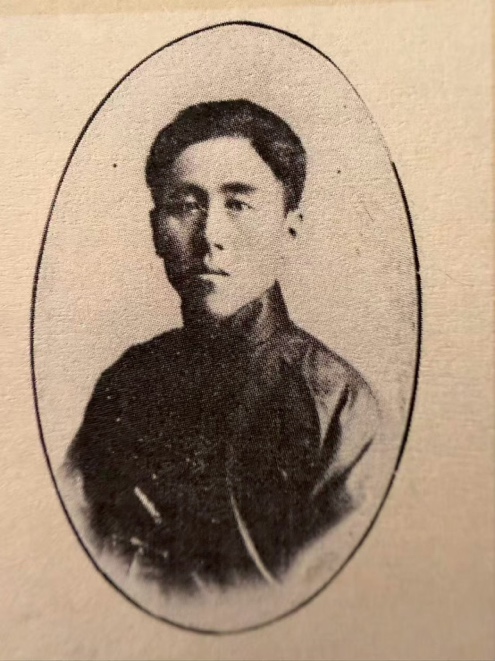
Wang Shoukang, 1925 graduate of the Department of Chinese Literature, Beijing Normal University